Liberty or Indian: what catches the eye
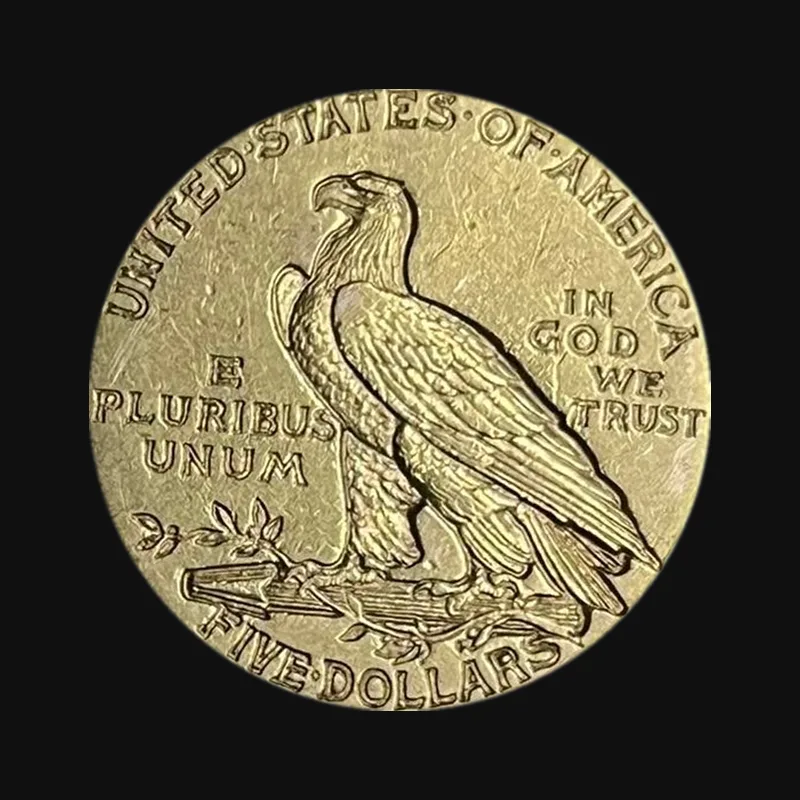
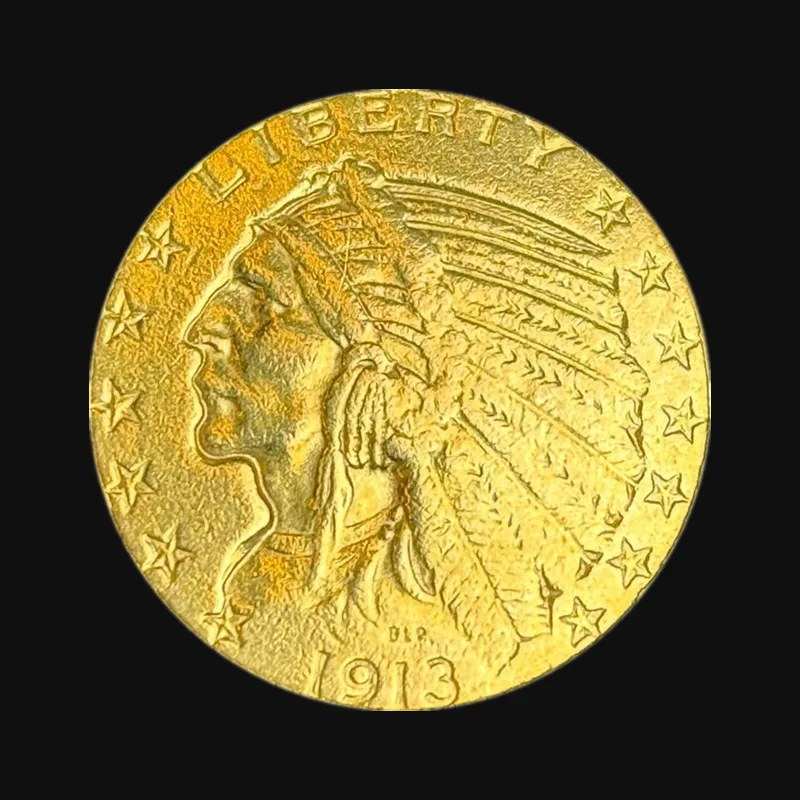
Lay the coin flat under a low, raking light. If the portrait stands out, wearing a coronet, it is a Coronet. If it looks engraved into the metal, showing a Native American crowned with feathers, it is an Indian Head. On this second type the smooth field rises above the design and takes the rubbing.
On the reverse, the Coronet's eagle spreads its wings, while Pratt's rests on a bundle of arrows. The Coronet shortens the value to “FIVE D.”, whereas the Indian Head writes it in full.
The letter D, a dating trap
Wikipedia notes that no other single-design American coin came out of seven mints, as the $5 Coronet did. Two of them nonetheless signed with a D: Dahlonega, in the Georgia mountains, opened to process gold mined locally, and Denver, decades later. A half eagle marked D and dated 1850 therefore comes from Georgia; dated 1907, from Colorado.
The other letters have their limits too: C from 1839 to 1861, O from 1840 to 1857 and again from 1892 to 1894, S from 1854 to 1906 on the Coronet, CC from 1870 to 1884 and again from 1890 to 1893. A letter outside those dates should raise suspicion.
Counterfeits: the signs NGC points out
For NGC, the $2.50 and $5 Indian Heads are among the series where genuine and fake are hardest to tell apart. It sees many copies from one shared reverse die, bearing an S mint mark and the dates 1909, 1913, 1915 or 1916. The telltale detail: an S with stretched ends and indistinct serifs, where the original has thick, almost square ones.
The sunken date also lends itself to tampering. NGC cites a piece offered as a 1919, a year in which no half eagle was struck: it was a 1913 whose 3 had been recut into a 9.
First reflexes before consulting a numismatist:
- weighing to a hundredth of a gram, around 8.36 g;
- a diameter of 21.6 mm with a caliper;
- a magnet: no pull at all for gold;
- the date: an Indian Head only exists from 1908 to 1916, and in 1929;
- the letter: an O on an Indian Head is only possible in 1909.
The exact weight does not prove authenticity. More method in the guide how to spot a fake coin.
Wear: a coin that wears inside out
On an ordinary coin, the raised parts of the portrait flatten first. The Coronet follows that rule: coronet, strands above the eye and wing tips lose their detail before the rest. The Indian Head does the opposite: since the design is recessed, the smooth areas of the field get scratched and polished, while the sheltered feathers often stay legible.
Many half eagles were set in jewellery or cleaned: a solder mark or an over-even shine can be spotted with a loupe. Levels of wear are described in the guide grades of preservation.
Quarter, half or eagle? Get out the caliper
Pratt's Indian also appears on the $2.50, and Gobrecht's Liberty on the $10. Diameter and mass sort them out: 18 mm and 4.18 g for the quarter eagle, 21.6 mm and 8.359 g for the half eagle, about 27 mm and 16.718 g for the eagle.
See also the pages on the $10 gold coin and the $20 gold coin, and all the foreign coins.