Three regimes, four portraits
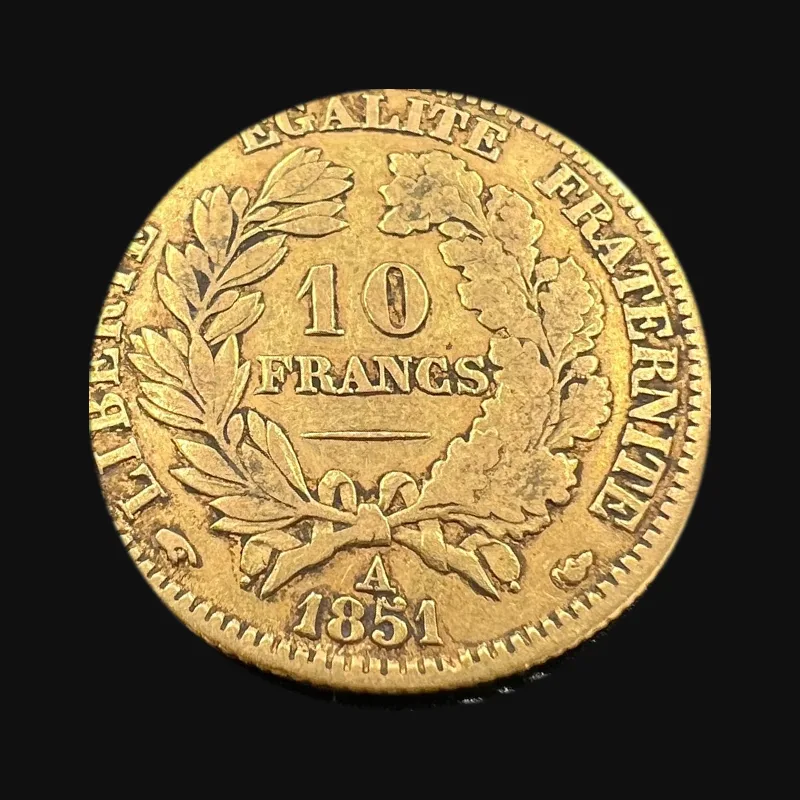
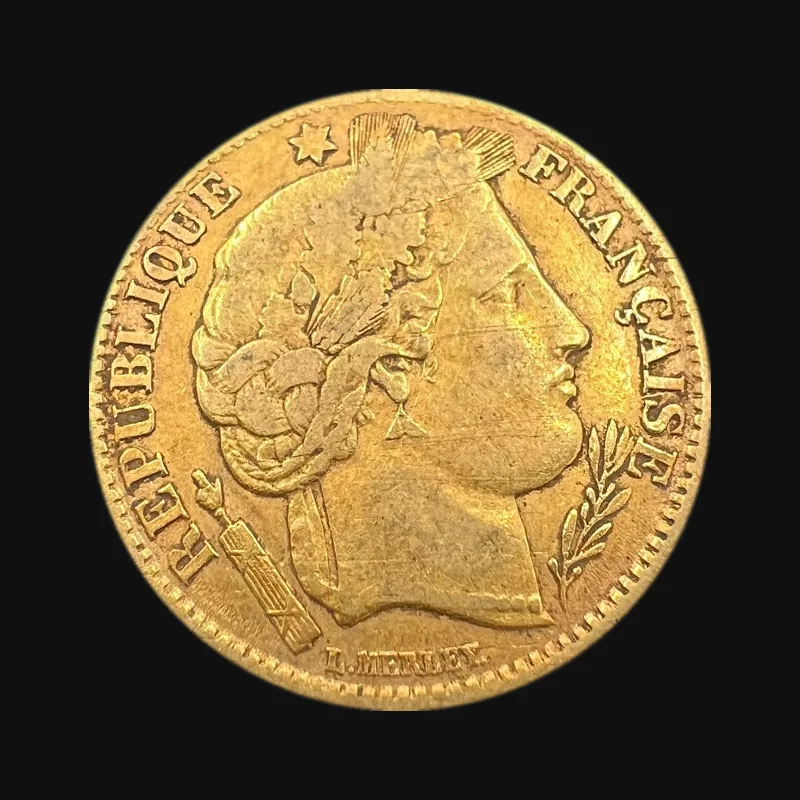
The coin appeared in 1850 under the Second Republic. The 20 and 40 francs had been circulating since 1803, but Californian gold flowing into Europe made a smaller gold coin useful for ordinary payments. The first design was Louis Merley's Ceres, the head of a goddess crowned with ears of wheat.
Under the Second Empire, striking resumed in 1854 on a very large scale: more than 60 million bare heads of 19 mm, then about 31 million laureate heads between 1862 and 1868. The Third Republic went back to Ceres from 1878 to 1899, with barely 2.4 million coins in all, before adopting Chaplain's Rooster in 1899, struck until 1914.
The First World War took gold out of circulation, and no circulating gold 10 francs was ever issued again. To place these types in their century, the page on 19th-century French coins (in French) gives the background.
Identifying your coin by elimination
Start with the reverse. A standing rooster, no mint letter: the coin dates from 1899 to 1914 and is a smaller version of the 20 francs Rooster. A “10 FRANCS” value surrounded by “EMPIRE FRANÇAIS”: it is a Napoleon III. With a republican legend, turn the coin over: a head with wheat ears means Ceres, and only the date tells whether it belongs to the Second or the Third Republic.
For Napoleon III, the laurel in the hair separates the laureate head (1862-1868) from the bare head (1854-1860). The bare head came in two diameters: about 17 mm in 1854-1855, 19 mm afterwards, with the same weight and therefore a thinner coin. The year 1855 has both. Finally, in 1862, a hybrid version shows a smaller “10” on the reverse.
A gold 10 francs with the winged Genius? There is none: that design was used only on the 20, 50 and 100 francs.
The mint letter, below the value
On Ceres and Napoleon III coins, a letter placed under “10 FRANCS” identifies the mint. Paris's A covers every type. Strasbourg's BB appears only under the Second Empire, from 1855 to 1868; it carries the rarest date of the series, 1855 BB, with about 32,000 coins, and another low date, 1858 BB. Third Republic Ceres coins all come from Paris, and the Rooster carries no letter at all. To learn how to read these marks, see the guide to French mints (in French).
Counterfeits and varieties: what can be checked
The low weight of the gold 10 francs makes a scale essential: to a hundredth of a gram, an authentic piece weighs very nearly 3.22 g, since wear takes off just a few hundredths. Then measure the diameter and above all the thickness with a calliper, then examine under a loupe the reeding of the edge and the drawing of the hair, often blurred on a copy. The full method is in the guide to spotting a fake coin (in French).
As for varieties, the loupe reveals several: on the 1850 Ceres, the raised or low ear (“oreille relevée”, “oreille basse”); on the 1854 small module, a plain edge (large or small A) or a reeded one; in Paris in 1860, two shapes of 6 and a particular privy mark; on the BB laureates of 1863 to 1866, a letter in two sizes; for the 1899 and 1900 Rooster, a matt flan without lustre. As for the burnished flans, 30 coins in 1878 and 100 in 1889, they were prepared for the World Fairs: an ordinary inheritance does not contain them.
Judging wear on such a small coin
The relief of a gold 10 francs is shallow: it does not take long in circulation for an Extremely Fine (SUP) coin to become Very Fine (TTB). The first points to fade depend on the type. Napoleon III: the hair above the ear and the goatee, and on the laureate head the veins of the leaves. Ceres: the wheat ears and the locks on the forehead, whose grains disappear at Fine (TB). Rooster: Marianne's hair over the forehead and the rim of her cap, then the bird's breast and wing.
On such small fields, the slightest scratch shows. A solder mark, a hole or a jewellery mount robs the coin of most of its numismatic interest. Do not try to make it shine: the reasons are in why not to clean a coin, the grading scale in the grading guide (both in French).