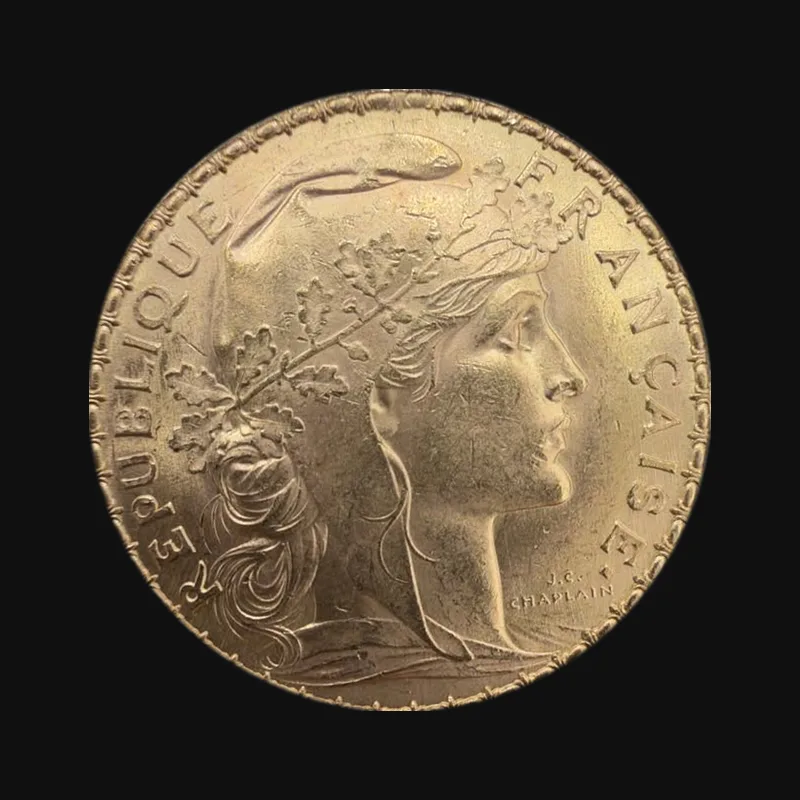
Obverse
Right-facing profile of Marianne, a Phrygian cap on her head with an oak wreath over it. Along the rim, in an arc: “RÉPUBLIQUE FRANÇAISE” (French Republic).
Written by the Maison Or & Bijoux Cannes team · updated
| Country | France |
|---|---|
| Metal | Gold, 900‰ fine; 1951-1960 restrikes slightly below |
| Weight | 6.45 g |
| Fine gold | 5.806 g |
| Diameter | 21 mm |
| Thickness | 1.30 mm |
| Striking period | 1899 to 1914, plus an extra batch in 1921 dated 1914 and restrikes from 1951 to 1960 dated 1907 to 1914 |
| Mint | Paris (no letter) |
| Period coins | 117,448,888: 43,034,473 with the “Dieu protège la France” edge, 74,414,415 with the “Liberté égalité fraternité” edge |
| Restrikes | 37,483,500 coins (1951-1960) |
| Catalogue | Le Franc F.534 and F.535 |
Marianne in a Phrygian cap on one face, a Gallic rooster on the other: this Third Republic napoléon, signed by Jules-Clément Chaplain, was struck in Paris between 1899 and 1914. Millions more left the Mint from 1951 to 1960, carrying old dates. Ordinary pieces are plentiful; collector interest focuses on a handful of early years and on examples in near-new condition.
Right-facing profile of Marianne, a Phrygian cap on her head with an oak wreath over it. Along the rim, in an arc: “RÉPUBLIQUE FRANÇAISE” (French Republic).
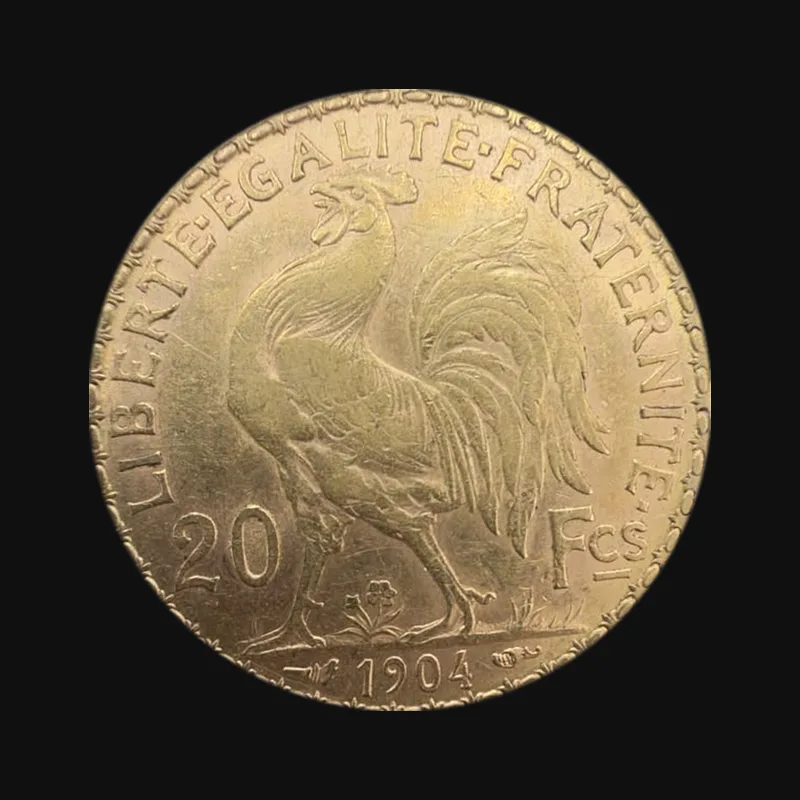
A Gallic rooster striding to the left, with the value “20 FRANCS” and the year on either side. Around it, the motto “LIBERTÉ ÉGALITÉ FRATERNITÉ”. No mint mark: the Paris Mint alone produced it.
Sixteen years, two edges. The figures below count only coins struck at the time: for the dates 1907 to 1914, 1950s restrikes come on top. The dates worth a close look, from the lowest mintage up: 1900, 1902, 1899 and 1901.
| Date | Edge | Period coins | Worth knowing |
|---|---|---|---|
| 1899 | Dieu protège la France | 1,500,000 | First date; matt flan known |
| 1900 | Dieu protège la France | 605,982 | Lowest mintage; 9,443 matt flans on top |
| 1901 | Dieu protège la France | 2,643,350 | Reduced mintage |
| 1902 | Dieu protège la France | 2,393,707 | Reduced mintage |
| 1903 | Dieu protège la France | 4,405,175 | Plentiful |
| 1904 | Dieu protège la France | 7,705,674 | Plentiful |
| 1905 | Dieu protège la France | 9,158,132 | Plentiful |
| 1906 | Dieu protège la France | 14,613,010 | Old edge, final year |
| 1907 | Liberté égalité fraternité | 17,715,935 | Series record; restrikes possible |
| 1908 | Liberté égalité fraternité | 6,721,325 | Restrikes possible |
| 1909 | Liberté égalité fraternité | 9,636,955 | Restrikes possible |
| 1910 | Liberté égalité fraternité | 5,779,072 | Restrikes possible |
| 1911 | Liberté égalité fraternité | 5,346,044 | Restrikes possible |
| 1912 | Liberté égalité fraternité | 10,331,805 | Restrikes possible |
| 1913 | Liberté égalité fraternité | 12,163,138 | Restrikes possible |
| 1914 | Liberté égalité fraternité | 6,720,141 | Includes the 1921 batch (202,359); restrikes possible |
Main source: French Wikipedia, based on the Le Franc catalogue, checked against BDOR. The two agree everywhere except 1900, where BDOR gives 615,425 by combining regular strikes and matt flans. None of the sources consulted splits the 37,483,500 restrikes year by year.
Before you even look at the date, turn the coin onto its edge. Two inscriptions exist. “DIEU PROTÈGE LA FRANCE” marks the first type, struck from 1899 to 1906. The republican motto marks the second, from 1907 to 1914, along with everything made again after the Second World War.
Edge and date have to tell the same story. A 1904 date with the motto, or a 1913 date with “DIEU PROTÈGE LA FRANCE”, matches no official striking: the coin is false.
The 1907 switch was no accident. It came two years after the 1905 law separating the Churches and the State, and the Republic then swapped the religious wording for its own motto.
In June 1951, the Paris Mint took up the Rooster dies again and, until 1960, struck fresh coins dated 1907 to 1914. Total: 37,483,500 pieces. According to French Wikipedia, the purpose was to act on the price of gold on the free market. The nickname “Pinay restrikes” refers to Antoine Pinay, head of government from 1952, although the operation was already under way.
These are not counterfeits: design, dies, weight and mint are all the same. The difference lies in the alloy, which holds a little more copper. Wikipedia gives 897.3 thousandths, AuCOFFRE a range of 898 to 900. The colour sometimes leans towards red and, since these coins saw little use, they often look very fresh.
No single sign settles it: lighting and toning alter the hue, and some period coins never circulated. Only a metal analysis gives a firm answer. Measured against output, restrikes account for roughly a third of the coins dated 1907 to 1914; their share among surviving coins is unknown. Collectors tend to look for period strikes, and a date between 1899 and 1906 removes any doubt.
At the top of the series sit the matt flan coins of 1899 and 1900: a dull ground, a slightly grainy surface. Next come the low-mintage years of the first type, led by 1900 with 605,982 coins, then 1902, 1899 and 1901.
Two oddities complete the picture. In 1921, the State still made 202,359 coins dated 1914, which nothing sets apart from the rest. Finally, the Le Franc catalogue records 1898-dated pre-series trials, also on matt flans, which in practice never appear in family lots.
Because it is everywhere, the Rooster has been widely imitated, and not always in poor gold. An accurate scale and a calliper are enough for a first sort: 6.45 g, 21 mm, 1.30 mm. Wear removes only a few hundredths of a gram; a larger gap should raise the alarm.
Under a loupe, be wary of Marianne's hair lacking finesse, rooster feathers that look melted, uneven edge lettering or a beaded border with a blurred outline. A mint mark on a Rooster is another warning sign, since the design has none. Further checks are described in the guide to spotting a fake coin (in French).
On the Marianne side, the first relief to wear is the hair above the forehead, together with the oak leaves decorating the cap; the cheek and the edge of the cap follow. Hair strands still apart and readable leaf veins place the coin at Very Fine (TTB in French grading). Hair reduced to a smooth surface takes it down to Fine (TB).
On the rooster side, the breast is the most exposed point, ahead of the wing and the comb. At Extremely Fine (SUP), each breast feather remains crisp.
The Rooster's broad empty fields, around the bird and behind the profile, keep the traces of knocks, fine scratches and rim nicks. A coin stored in a bag can be covered in them without ever circulating, and these marks weigh on the grade. No cleaning, ever: the reasons are in why not to clean a coin, the full scale in the grading guide (both in French).
The Rooster replaced the 20 francs Genius in 1899, with a new design but the same standards as the germinal franc of 1803: same weight, same fineness. The Second Empire's Napoleon III 20 francs therefore holds exactly the same amount of gold.
The 1914 war ended gold's place in everyday life. In 1915, Abel Faivre's poster “Pour la France, versez votre or” (For France, pour out your gold) urged the French to exchange their coins for banknotes. The Rooster stopped being money and became a reserve to be kept.
By the time the Rooster went into circulation, Cannes was already living off its winter season. The trend goes back to December 1834: Lord Brougham, unable to reach Italy because the border of the County of Nice had been closed over cholera, stopped in Cannes, had the Villa Éléonore-Louise built and invited the English aristocracy. Through the 19th century, English and Russian families built their residences there. A family estate in the area can therefore bring together Rooster 20 francs and gold from elsewhere, such as US 20 dollar gold coins or coins of Monaco. You can bring your Rooster to the Cannes shop to have its edge and date read, or ask for a free coin valuation.
Perhaps, but not necessarily: the dates 1907 to 1914 were struck again between 1951 and 1960. A reddish colour and a very new look are hints of a restrike, not proof; the alloy has to be analysed to be sure.
Yes, if the dates differ: “DIEU PROTÈGE LA FRANCE” up to 1906, the republican motto afterwards. On the other hand, an edge that does not match the date points to a counterfeit.
Very slightly: its fineness is a little under 900 thousandths (897.3 according to French Wikipedia, 898 to 900 according to AuCOFFRE). Weight and design are those of the original coin.
1900, struck in 605,982 examples, and even more its 9,443 matt flan coins. Then 1902, 1899 and 1901.