Skip to content
France

The gold 20 francs Genius

France · 1848-1898 · Gold

Written by the Maison Or & Bijoux Cannes team · updated

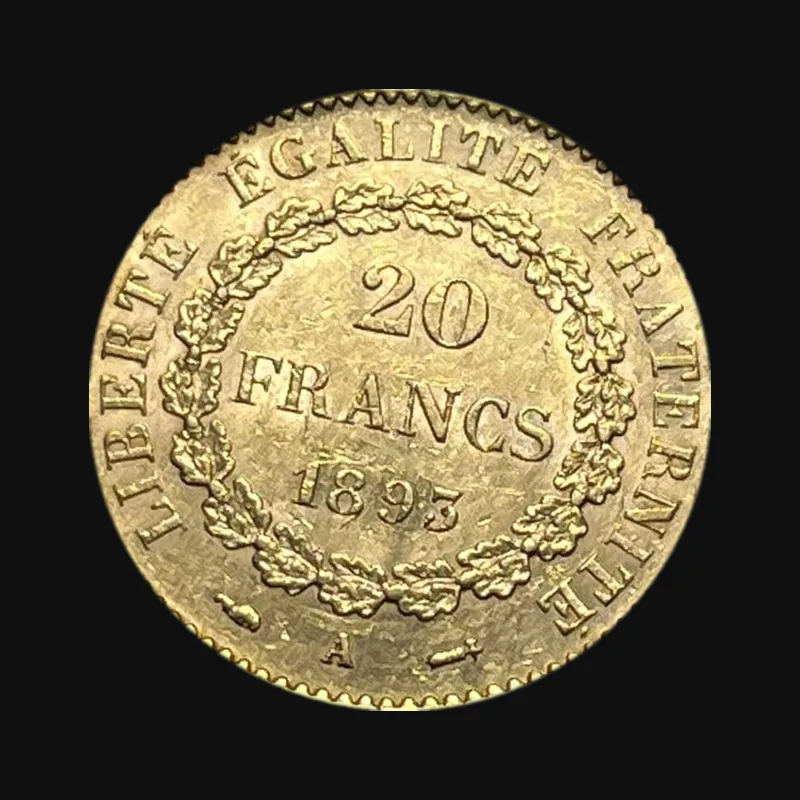
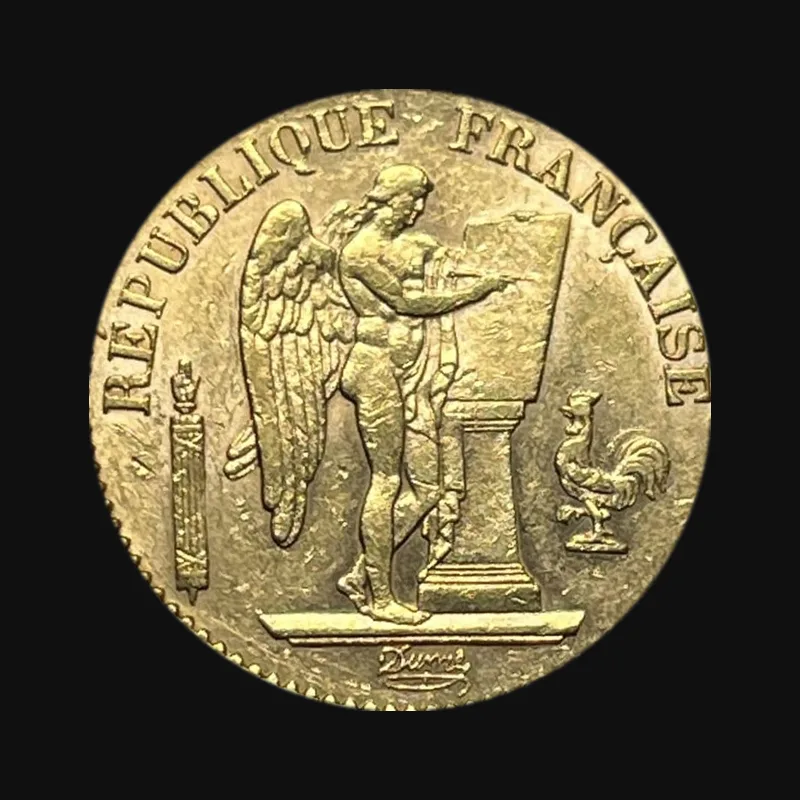
20 francs gold “Génie”, obverse: the Genius engraving the Constitution20 francs “Génie” dated 1893, Paris mint (A), reverse with the value in a wreath
Photos: Maison Or & Bijoux.
Specifications
CountryFrance
MetalGold, 900‰ fine
Weight6.45 g
Fine gold5.806 g
Diameter21 mm
Striking1848 and 1849, then 1871 to 1898
MintParis Mint (A)
Total mintage2,846,061 under the Second Republic; about 86 million under the Third
CatalogueLe Franc F.528 (Second Republic), F.533 (Third Republic)

A winged figure writes on a tablet, with a fasces on one side and a rooster on the other: this is the 20 francs Genius (Génie in French). Augustin Dupré's design, created in 1792, was used twice for this napoléon, under the Second Republic and again under the Third, always at the Paris Mint. Close to 89 million coins were made; only a handful of dates, struck in small numbers, really interest collectors.

Identification

The gold 20 francs Genius: how to recognise it

20 francs gold “Génie”, obverse: the Genius engraving the Constitution

Obverse

Standing and facing right, the winged Genius of the Republic writes on a tablet set on an altar. Behind him, a fasces topped by a hand of justice; in front of him, a rooster. The signature “Dupré” sits below the scene, and the legend “RÉPUBLIQUE FRANÇAISE” (French Republic) runs around it.

20 francs “Génie” dated 1893, Paris mint (A), reverse with the value in a wreath

Reverse

In the middle of a closed wreath: “20 FRANCS”, the year, then the letter A of the Paris mint. All around: “LIBERTÉ ÉGALITÉ FRATERNITÉ”.

Edge
Raised lettering “DIEU * PROTEGE * LA * FRANCE” (God protect France), the same under both Republics. One exception: the 30 proof-like pieces on burnished flans of 1878, which have a plain edge.
Engraver
Augustin Dupré, chief engraver of the coinage during the Revolution, created the design in 1792. The Second Republic took it up unchanged in 1848, the Third in 1871.
Dates and mintages

The gold 20 francs Genius: key dates

No mint letters to compare: every Genius carries the A of Paris, so only the date matters. The big mintages of 1875-1878 and 1895-1898 make up most of the coins still kept in families. The trough lies between 1886 and 1894; 1888 is by far the rarest date there, followed by 1892.

The gold 20 francs Genius: dates and mintages
YearMintMintageNote
1848A1,543,091Second Republic; burnished flan also known
1849A1,302,970Second and last year of the Second Republic
1871A2,508,494The Third Republic revives the type
1874A1,284,554Nothing in 1872-1873
1875A11,677,031Plentiful
1876A8,824,658Plentiful
1877A12,759,057Series record
1878A9,188,600Plus 30 burnished flans, plain edge
1879A1,037,522Privy mark: plain or barred anchor
1886A984,875First date after 1879
1887A1,231,487Few struck
1888A27,707Rarest of the regular dates
1889Aabout 850,000 to 875,000Total disputed; 100 burnished flans
1890A1,030,140Average mintage for the period
1891A871,101Few struck
1892A225,706Second rarest date
1893Aabout 2.5 millionUncertain total, plentiful coin
1894A490,838Few struck
1895A5,293,347Plentiful
1896A5,330,407Privy mark: fasces or torch
1897A11,068,977Plentiful
1898A8,866,327Final date of the type

The 1871-1898 figures come from Numista, which follows the Le Franc catalogue (F.533/1 to F.533/23), cross-checked for 1874, 1875 and 1879 against CoinVarieties; those for 1848-1849 come from BDOR. Sources disagree on two years: 853,468, 873,000 or 873,090 coins in 1889, and 2,457,168, 2,517,168 or 2,547,168 in 1893. The Third Republic total is therefore only approximate, around 86 million. No coins were made from 1880 to 1885.

A revolutionary design used twice

The design dates from 1792: Augustin Dupré created it for the coins of the newborn First Republic. It came back in 1848, when the Second Republic chose it for its gold 20 francs, made in 1848 and 1849 only. The next regime brought in the imperial portrait, that of the Napoleon III 20 francs.

From 1871, right after the fall of the Empire, the Third Republic went back to the Genius. It produced plenty in the 1870s, stopped all striking from 1880 to 1885, then made few until 1894: that lean period is what left the rare dates. From 1895, the Mint returned to several million coins a year. Bound by the standards of the Latin Monetary Union, the Genius remained everyday money until the 1914 war.

Chaplain's 20 francs Rooster replaced it in 1899. Dupré's design lived on, though, on the large gold coins: the 50 francs until 1904, the 100 francs until 1914. The page on Third Republic coins (in French) sets the coin among its contemporaries.

Privy marks, burnished flans and fakes to watch

Only one mint struck the Genius, Paris; any letter other than A under the wreath is a warning sign. The recognised varieties concern the privy marks, small reverse symbols belonging to the chief engraver and to the Mint director. Two years have two of them: 1879, with a plain or barred anchor, and 1896, with a fasces or a torch, which Le Franc numbers separately. Set apart, the burnished flans of 1848, 1878 (30 coins) and 1889 (100 coins) were presentation pieces.

The rarer a date, the more it tempts forgers. An 1888 or an 1892 therefore deserves a look at the last digit under a loupe: shape, alignment, the surface of the nearby field, tool scratches. A common coin with a re-engraved date still holds its gold, but it is no rare date.

Other fakes copy the whole coin, sometimes in gold of the right fineness. Be wary of wings with blurred feathers, a thick rooster, badly spaced edge letters or a weight that strays from 6.45 g. At 21 mm across with a crisp edge, the coin passes the first test; the next steps are explained in the guide to spotting a fake coin (in French).

Judging the grade of a Genius

On this small coin, the low-relief scene wears in a very readable way. The head, shoulder and chest of the Genius, the highest points, fade first. The wings follow, their feathers losing their outlines. The rooster and the rods of the fasces come after.

Feathers still separate and a sharply cut profile: the coin is Very Fine (TTB in French grading). Wings reduced to a flat area and a rooster without detail: it drops to Fine (TB). On the other side, watch the veins of the wreath leaves, a good witness of wear. The legends around the rim, on the contrary, hold up for a long time and do little to help.

Even with little circulation, a Genius often bears small knocks in the fields, left by contact with other coins, and the grade takes them into account. Above all, no cleaning: the original lustre never comes back. The grading guide and the page on why not to clean a coin (both in French) cover these points.
In Cannes

The gold 20 francs Genius on the French Riviera

When the Second Republic struck its first Genius coins, in 1848-1849, Cannes was still a commune of the Var department, within the arrondissement of Grasse. It joined the Alpes-Maritimes only in 1860, when that new department was formed from the County of Nice, newly French, and the arrondissement of Grasse, taken from the Var. Three years later, on 10 April 1863, Cannes station opened to passengers. The Third Republic's Genius coins thus reached a town linked to the railway and turned into a winter resort. In a Cannes estate, they often sit alongside Napoleon III 20 francs or Roosters; at the Cannes shop, a numismatist can read the date and edge of each one, or you can ask for a free coin valuation.

The gold 20 francs Genius: frequently asked questions

How do I date a 20 francs Genius when every coin comes from Paris?

Simply read the year under “20 FRANCS”: 1848 or 1849 point to the Second Republic, any year from 1871 to 1898 to the Third. Both series carry exactly the same design.

My Genius is dated 1888: is it necessarily rare?

The date is, with only 27,707 coins. It still has to be original: a final 8 re-engraved on a common year is the most obvious trap. Have the coin checked by a numismatist before drawing any conclusion.

Are there Genius coins struck anywhere other than Paris?

The catalogues know of none. A letter other than A, or an A that looks retouched, calls for a careful check.

Are the Genius and the “angel” the same coin?

Yes. “Angel” (ange) is the popular French nickname for Dupré's winged figure, which stands for the Genius of the Republic and not for a religious being.