Skip to content
United States

Silver Morgan Dollar (1878-1921)

United States · 1878-1921 · Silver

Written by the Maison Or & Bijoux Cannes team · updated

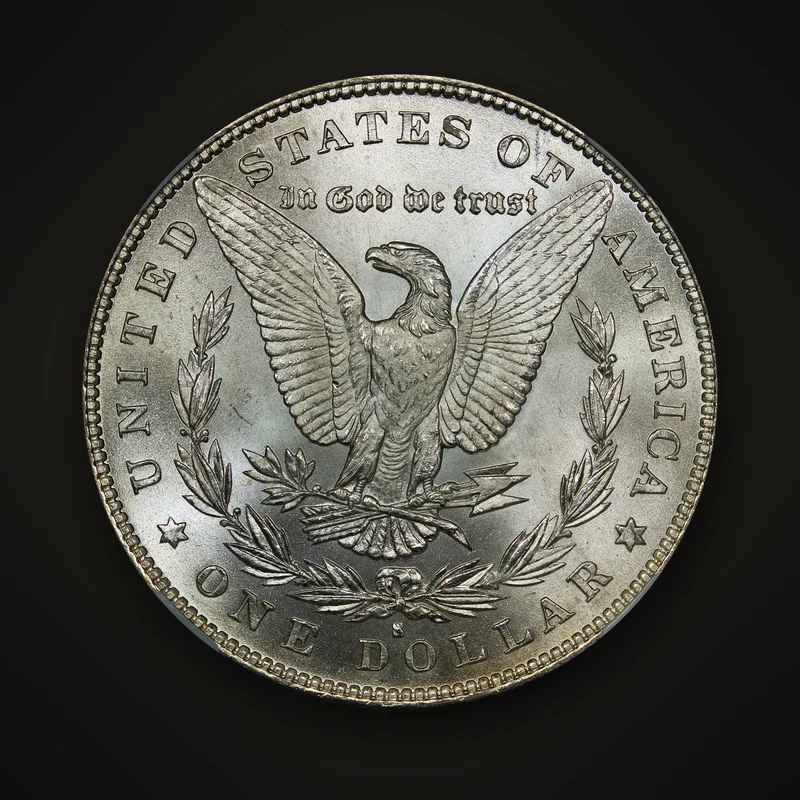
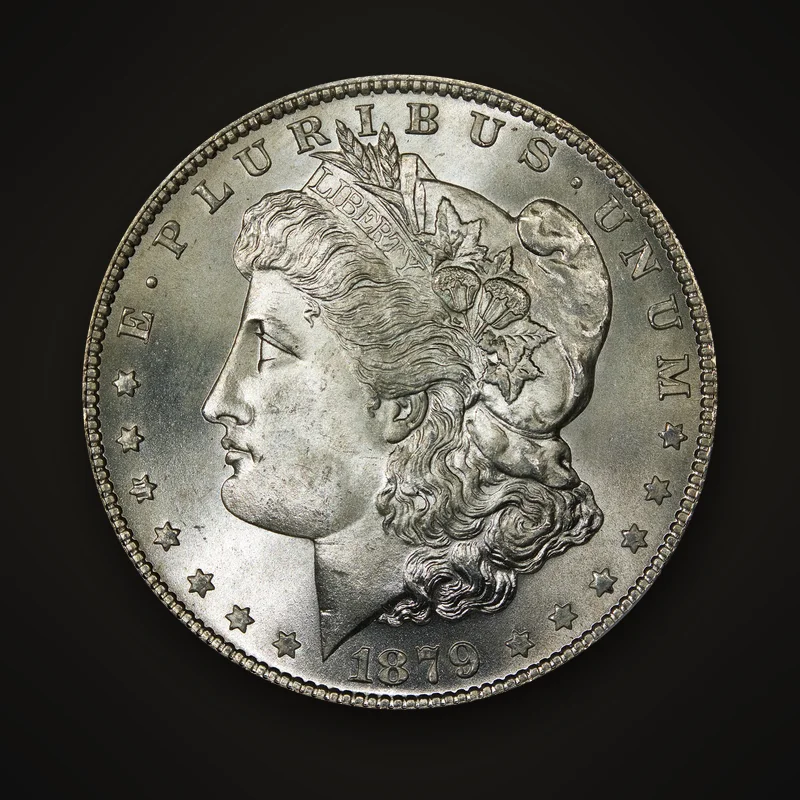
1879 silver Morgan Dollar struck in San Francisco, obverse: head of Liberty wearing a Phrygian cap1879 Morgan Dollar, reverse: eagle with outspread wings within a laurel wreath, S mint mark
Photos: Brandon Grossardt, CC BY-SA 3.0, via Wikimedia Commons, cut out on a black background.
Specifications
CountryUnited States
MetalSilver, 900‰ fine (10% copper)
Weight26.73 g
Fine silver24.057 g
Diameter38.1 mm
Thickness2.4 mm
Years struck1878-1904 and 1921; collector issues in 999‰ silver since 2021
MintsPhiladelphia (no letter), Carson City (CC), New Orleans (O), San Francisco (S), Denver (D, in 1921 only)
EngraverGeorge T. Morgan
EdgeReeded
ReferencesKM# 110

A silver one-dollar coin of the United States, the Morgan was struck from 1878 to 1904, then one last time in 1921. A profile of Liberty in a cap, an eagle with wide-open wings and a 38 mm diameter are enough to identify it. With more than 650 million coins struck, it is one of the American coins most often found in collections, on this side of the Atlantic too.

Identification

Silver Morgan Dollar (1878-1921): how to recognise it

1879 silver Morgan Dollar struck in San Francisco, obverse: head of Liberty wearing a Phrygian cap

Obverse

Profile of Liberty looking left, under a Phrygian cap trimmed with ears of wheat and cotton bolls; the band of the cap reads “LIBERTY”. The motto “E PLURIBUS UNUM” runs across the top, thirteen stars are spread around the bust and the date fills the bottom of the coin.

1879 Morgan Dollar, reverse: eagle with outspread wings within a laurel wreath, S mint mark

Reverse

Eagle with open wings clutching arrows and an olive branch, inside a laurel wreath. Around it are “UNITED STATES OF AMERICA” and “ONE DOLLAR”; above the eagle, “IN GOD WE TRUST” is written in Gothic letters. When the coin carries a mint mark, it sits just below the wreath, above the “DO” of “DOLLAR”.

Edge
Reeded edge, no inscription.
Engraver
Designed by George T. Morgan, then assistant engraver at the Philadelphia Mint, who signed with an “M” under Liberty's neck and on the bow of the wreath. The model for the profile was a Philadelphia resident, Anna Willess Williams.
Dates and mintages

Silver Morgan Dollar (1878-1921): key dates

Two pieces of information are enough to place a Morgan Dollar: the year, on the Liberty side, and the mint mark, on the eagle side, below the wreath. A date that is ordinary in Philadelphia can be rare in San Francisco or New Orleans. The Carson City coins (CC) and those of 1893 supply most of the rarities, while 1921 is by far the most widespread date.

Silver Morgan Dollar (1878-1921): dates and mintages
YearMintMintageRemarks
1878no letter10,508,800Opening year; the reverse goes from eight to seven tail feathers during striking.
1878CC2,212,000Start of striking at Carson City.
1878S9,774,000Easy to find.
1879CC756,000Sought-after CC date.
1881CC296,000Small mintage, partly kept in bags.
1884S3,200,000Ordinary when worn, very rare without wear.
1885CC228,000One of the two smallest CC mintages, with 1881.
1889CC350,000The most coveted Carson City date.
1892S1,200,000Very few uncirculated coins known.
1893no letter378,0001893 crisis: reduced output everywhere.
1893O300,000Rare.
1893CC677,000End of striking at Carson City.
1893S100,000Smallest circulation mintage of the type, a favourite target of forgers.
1894no letter110,000Rare.
1895no letter880Proofs only; no circulation strike known.
1895O450,000Rare, even more so in good condition.
1895S400,000Rare.
1899no letter330,000Small mintage for Philadelphia.
1901no letter6,962,000Ordinary when worn, rare uncirculated.
1903O4,450,000Rare until bags held by the Treasury were released.
1904S2,304,000Last date before the halt.
1921no letter44,690,000Re-engraved dies, flatter relief; most frequent date.
1921D20,345,000Denver's only year.
1921S21,695,000Easy to find.

Figures taken from the Wikipedia (en) table, checked for key dates against the PCGS, Numisview and Coinweek guides. Of the 96 year and mint combinations, only the main rarities and a few common dates used as reference points are listed.

Altered coin, copy or original?

Two kinds of fakes circulate. The simplest are complete copies, most often in silvered white metal. They give themselves away on the scales (an original weighs 26.73 g), by a dull sound when rung, and sometimes because they react to a magnet.

The most deceptive are genuine coins that have been altered. The forger takes an 1893 Philadelphia coin and attaches an S to imitate the 1893-S; adds CC to an ordinary 1889; or removes the S from an 1895-S to obtain a fake 1895 Philadelphia. Since the metal and weight are original, no simple test is enough. The area around the letter must be examined under a loupe (tool scratches, traces of solder, a field re-polished at that spot) and the shape of the date numerals compared with a reliable coin.

For the dates mentioned here, show the coin to a numismatist before drawing any conclusion: see our coin valuation page.

The varieties collectors look for

The first year is the richest. In 1878, the eagle first has eight tail feathers; the Mint then switched to seven, and some coins show the seven feathers re-engraved over the eight. A loupe and a reference picture are needed to tell them apart.

In 1921, new dies had to be engraved. The result shows: shallower relief, hair and feathers less detailed than on the 19th-century coins.

Philadelphia also struck proofs for most years, recognisable by their mirror-polished fields. Some circulation strikes have a similar look, which collectors call prooflike. Finally, the Carson City dollars sold to the public by the General Services Administration between 1972 and 1980 are often still found in their original black plastic holder.

Morgan, Peace, Trade: telling them apart

The Peace Dollar, struck from 1921 to 1935, replaced the Morgan with the same weight and the same silver. Liberty wears a radiate crown, and the eagle on the reverse, perched on a rock, comes with the word “PEACE”. The Seated Liberty dollar, earlier than 1873, shows a seated Liberty. The Trade Dollar (1873-1885), created for trade with Asia, is slightly heavier and says so in full: “TRADE DOLLAR”.

Since 2021, the US Mint has reused the design for collector issues in 999‰ silver; their recent date leaves no doubt. As for the replicas sold as souvenirs, with no silver, they sometimes carry a small “COPY” and weigh well under 26.73 g.

For American gold coins, see the $20 gold coin.

Wear and toning: what matters on a Morgan

The Morgan saw heavy use in the American West, but millions of coins never left the Treasury bags. You therefore meet both extremes: dollars smoothed by use and coins that stayed new. On the obverse, watch first the locks above the ear and on the forehead, then the wheat ears and cotton leaves of the cap. On the reverse, the eagle's breast loses its feathers first, followed by the tops of the wings and the talons.

An uncirculated coin keeps a mint lustre that turns under the light. It almost always shows bag marks, left by contact with other coins; their number, and above all their presence on Liberty's cheek, weigh heavily in the assessment. Over the years, silver takes on a grey, sometimes coloured toning: this is normal. Silver polish removes it, but takes the original lustre with it, with no way back.

A dollar born of a silver law

On 28 February 1878, Congress passed the Bland-Allison Act over President Hayes's veto. The Treasury now had to buy between 2 and 4 million dollars' worth of silver each month and turn it into coin. The Nevada mines were running flat out, and the nearby Carson City Mint took part in the striking, which began on 11 March 1878. In 1890, the Sherman Silver Purchase Act increased these purchases further; its repeal on 1 November 1893, in the middle of a financial crisis, explains the low mintages of 1893 and 1894.

With no more purchased metal, striking stopped in 1904. In 1918, the Pittman Act allowed 270,232,722 silver dollars to be melted, most of the metal going to the United Kingdom. The same law then required silver to be bought back to replace these coins: the Morgan therefore returned in 1921, with new dies, before giving way to the Peace Dollar the same year.

In the early 1960s, the Treasury found in its reserves just over 2.8 million Carson City dollars that had never been released. The General Services Administration sold them to the public in seven sales, from 1972 to 1980.
In Cannes

Silver Morgan Dollar (1878-1921) on the French Riviera

The Morgan Dollar never served as money in France, and no historical fact links it specifically to Cannes. The American presence on the French Riviera is, however, well documented: after the Second World War, the harbour of Villefranche-sur-Mer hosted the United States Sixth Fleet, whose headquarters only left for Gaeta, in Italy, in January 1967. Nothing proves, though, that its sailors left silver dollars behind in the area. If a Morgan turns up among your family belongings, the Cannes shop can help you read its date and mint mark.

Silver Morgan Dollar (1878-1921): frequently asked questions

How do I tell a Morgan Dollar from a Peace Dollar?

The Morgan shows Liberty in a cap and an eagle with open wings inside a wreath. The Peace, struck from 1921, shows Liberty with a radiate crown and an eagle perched on a rock, with the word “PEACE”.

My Morgan is dated 1893 and has an S: what should I do?

Do not jump to conclusions. The 1893-S is the most imitated date in the series, often by adding an S to a Philadelphia coin. Have the letter examined under a loupe by a numismatist.

Is a Morgan dated 2021 or later an old coin?

No. These are collector issues from the US Mint, in 999‰ silver, reusing the 1878 design. The date is enough to recognise them.

My dollar barely weighs 20 g: is it genuine?

Probably not. An original Morgan weighs 26.73 g for a 38.1 mm diameter. Such a clear gap almost always points to a copy in base metal.