Profile, reverse, letter: the method
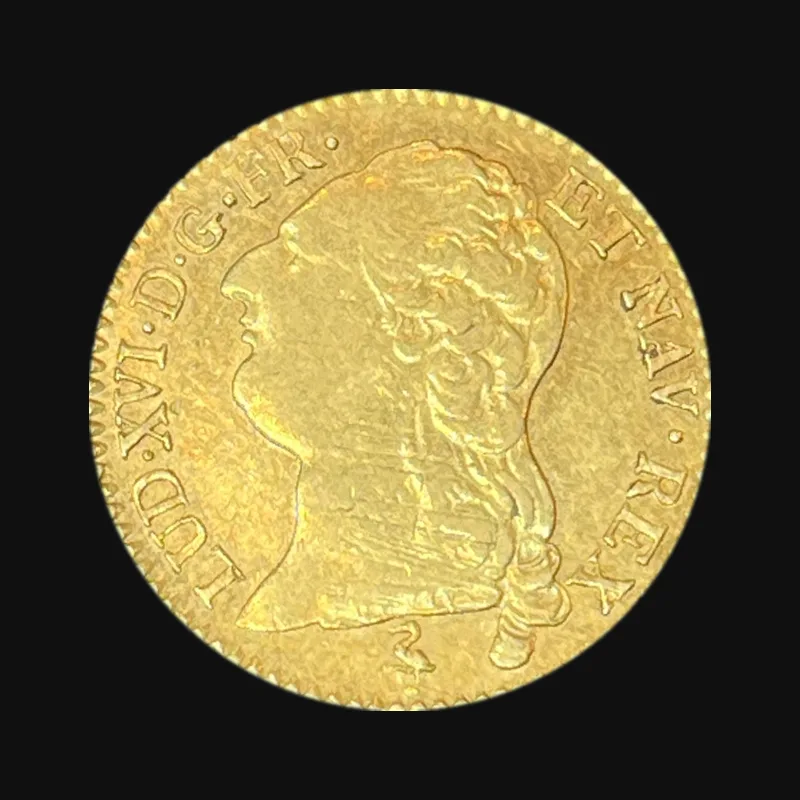
The first clue is the profile. Facing right, it normally points to Louis XIII or Louis XIV; facing left, to Louis XV or Louis XVI. The Roman numeral after LVD in the legend settles any doubt.
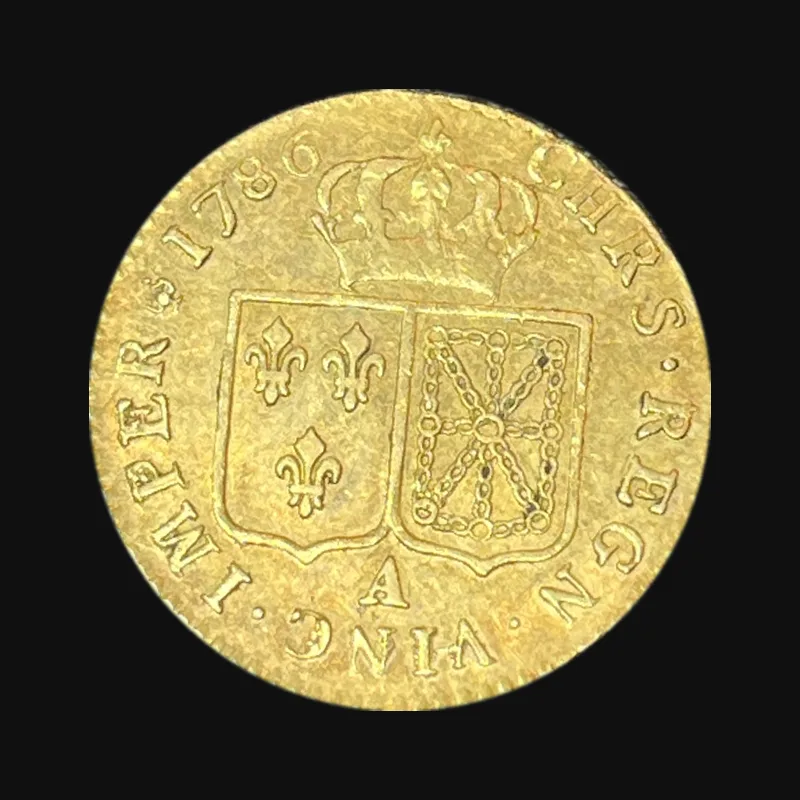
Next comes the reverse, which gives the period: a cross of Ls, a sun at the heart of that cross, two oval shields side by side, two square shields. The table above matches each design with its years.
That leaves the mint letter. A means Paris, D Lyon, & Aix, K Bordeaux. It may be under the bust, under the shields or in the middle of the cross, depending on the type, and the date is never far away.
A weight that follows the kingdom's recoinages
At its birth in 1640, the louis held a little over 6.75 g of gold at 22 carats. Coins were made on a screw press: the blanks are regular and any clipping of the rim shows at once. That weight held for nearly seventy years.
In 1709, a recoinage created the sun louis, raised to 8.158 g. The Regency years were turbulent: the Noailles louis reached 12.235 g, the types of 1718 to 1723 about 9.79 g, and the mirliton of 1723 dropped back to 6.525 g.
An edict of January 1726 brought back 8.158 g, which remained the norm up to the first louis of Louis XVI. The 1785 reform finally set the louis at 7.649 g, with two square shields on the reverse.
A coin much lighter than its type therefore deserves a close look: it may have been clipped, worn, holed and repaired, or made fraudulently.
Half louis and double louis
The half louis repeats the design of the louis at half its weight: 3.376 g before 1709, then about 4.08 g for the sun louis, the spectacles louis and the headband louis. It measures close to 20 mm.
The double louis, on the other hand, is missing from several series. According to Numista, it exists under Louis XIII; under Louis XIV for the shield, four Ls, insignia and sun types; under Louis XV for the headband, old head and mirliton; and under Louis XVI for both of his types. With square shields, it measures about 28 mm.
The 4, 8 and 10 louis pieces that left the Paris Mint in 1640 are a separate case: ceremonial coins that were not used for ordinary payments.
Restruck, mounted or imitated coins
In the 1690s, instead of melting louis down, the mints often restruck them with a new design: this was the time of the réformations. It is not unusual to make out letters or an outline of the old type beneath the newer one. The catalogues describe this; it does not betray modern manufacture.
Many louis also ended up as jewellery. Visible solder on the edge, the trace of a loop or a filled hole: these marks sharply reduce collector interest, without taking away the coin's authenticity.
Then there are copies, in low-grade gold or gilt metal. Weigh to the hundredth of a gram, measure the diameter and study how crisp the lettering is.
Judging the condition of a louis
Wear first attacks the relief of the portrait: the locks above the ear, the laurel wreath or headband, the cheek. On Louis XV and Louis XVI, the curls of the hair are the first to fade.
On the reverse, look at the crowns above the Ls or shields. If their pearls no longer stand apart, the coin has circulated for a long time. The lilies on the shields lose their sharpness at the same pace.
Rubbing or cleaning leaves a web of very fine scratches and costs one grade or more, so leave the coin as it is and show it to a numismatist. For a valuation, see our coin valuation page.