Skip to content
France

The French 50 francs gold coin

France · 1855-1904 · Gold

Written by the Maison Or & Bijoux Cannes team · updated

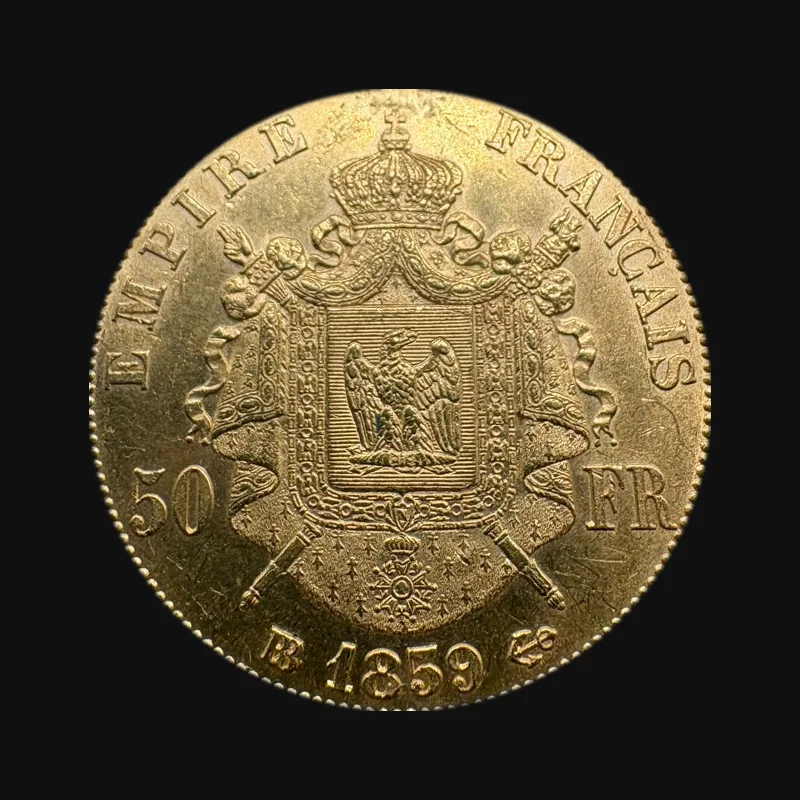
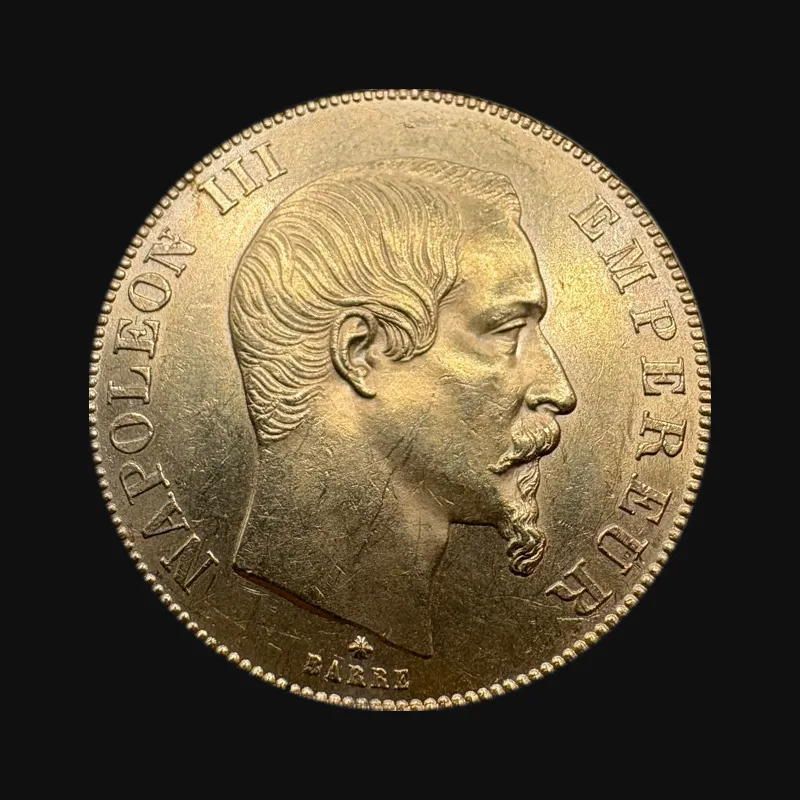
50 francs gold Napoleon III bare head, obverse50 francs gold dated 1859, Strasbourg mint (BB), reverse with the imperial arms
Photos: Maison Or & Bijoux.
Specifications
CountryFrance
MetalGold, 900‰ fine
Weight16.13 g
Fine gold14.516 g
Diameter28 mm
Striking periodsBare head 1855-1859; laureate head 1862-1868; Genius 1878-1904
MintsParis (A) and BB under the Empire, Paris alone under the Republic
EngraversJacques-Jean and Désiré-Albert Barre; Genius designed by Dupré
EdgeRaised: DIEU PROTEGE LA FRANCE
Combined mintagesBare head 764,385; laureate head 166,989; Genius 26,975 (30 burnished flans included)
CataloguesF.547, F.548 and F.549 (Le Franc); Gadoury 1111 and KM 785 for the bare head, Gadoury 1113 for the Genius (CoinVarieties)

At 28 mm across, the 50 francs gold coin is recognised first by its size: larger than a napoléon, smaller than a 100 francs. It weighs 16.13 g of gold at 900 thousandths. Three designs follow one another: the emperor without a wreath from 1855 to 1859, the emperor crowned with laurel from 1862 to 1868, then, from 1878 to 1904, the Genius of the Republic, struck in such small numbers that it remains the exception.

Identification

The French 50 francs gold coin: how to recognise it

50 francs gold Napoleon III bare head, obverse

Obverse

The emperor's profile facing right, with the legend “NAPOLEON III EMPEREUR” and the name BARRE below the neck; from 1862 a laurel wreath circles the head. Under the Republic, a winged Genius writes on a tablet, a rooster and a fasces beside him, with the legend “RÉPUBLIQUE FRANÇAISE”.

50 francs gold dated 1859, Strasbourg mint (BB), reverse with the imperial arms

Reverse

Empire: the imperial arms, meaning an eagle on a thunderbolt inside a shield ringed by the collar of the Legion of Honour, in front of a mantle; legend “EMPIRE FRANÇAIS”, the value “50 FR” split on either side of the shield, date and mint mark below the arms. Republic: value and date in the middle of a wreath.

Edge
Raised lettering “DIEU PROTEGE LA FRANCE”. Plain on some 1855 coins and on the patterns and burnished flans of 1862, 1868 and 1878.
Engraver
Désiré-Albert Barre signed the laureate head. Credit for the bare head varies: BDOR and Abacor give it to the same Désiré-Albert, CoinVarieties to his father Jacques-Jean. The Genius was engraved by Désiré-Albert Barre after Augustin Dupré's composition of 1792.
Dates and mintages

The French 50 francs gold coin: key dates

The 25 rows below cover every known pairing of date and mint. Find the letter first: under the Empire, BB appears in eight years and even outstrips Paris in 1859 and 1867. On scarcity, three imperial dates stay below 5,000 coins (1865 A, 1868 A, 1868 BB), and five Genius dates out of six never exceed a few thousand pieces.

The French 50 francs gold coin: dates and mintages
YearMintMintageRemarks
1855A151,754Plain edge known
1855BB6,854BB begins
1856A96,564No BB
1857A319,501Record for the denomination
1858A85,140
1858BB9,135Under 10,000
1859A34,025Last Paris bare head
1859BBabout 61,400Ahead of Paris (figure debated)
1862A24,418Laurel arrives
1862BB7,310
1863BB8,251BB without Paris
1864A28,682
1865A3,740Under 4,000, see the note
1866A39,155Peak of the laureate head
1866BB17,307
1867A11,671
1867BB20,437BB ahead of Paris
1868A4,223Scarce
1868BB1,795Smallest mintage
1878A5,294Genius, plus 30 burnished flans
1887A301Scarce Genius
1889A100Genius, burnished flans
1896A800Uncommon Genius
1900A200Scarce Genius
1904A20,250Most frequent Genius

Figures from BDOR and Abacor, which agree except for 1859 A (34,025 against 34,063); the list of date and mint pairs follows Le Franc (F.547/1-8, F.548/1-11, F.549/1-6). The 1859 BB is disputed: 61,374 coins for BDOR and Abacor, 61,354 for CGB after Le Franc, 61,534 for CoinVarieties, only 32,000 in the Krause catalogue quoted by Greysheet, hence the rounded figure in the table. The Genius total of 26,975 includes the 30 burnished flans of 1878 (26,945 without them according to CoinVarieties). For 1855 BB, CoinVarieties gives 6,850.

A gold coin of the Second Empire

According to BDOR and Abacor, the 50 francs denomination was created by an imperial decree of 12 December 1854. The first coins left the presses of Paris and of the BB mint in 1855, with a bare-headed Napoleon III. In 1862 the profile received a laurel wreath, as happened at the time on every gold coin of the Empire. Production stopped in 1868.

The overall figure stays low: just over 930,000 imperial coins, when the 20 francs napoléon was being struck by the million every year.

After 1870 the Republic took up the value again with the Genius, irregularly: six years only, including 1878 and 1889, two dates linked to the Paris Universal Exhibitions. Only the 1904 issue really passed 20,000 coins. The wider background is set out on the page about 19th-century coins.

Dating a 50 francs at a glance

Everything starts with the portrait. Beard and moustache with no wreath: bare head, 1855 to 1859. Same face with laurel leaves: laureate head, 1862 to 1868. A winged figure leaning over a tablet: Genius, 1878 to 1904.

Then turn the coin over. At the bottom of the imperial reverse, beside the year, stands the letter A (Paris) or BB. No other mint, neither Lyon nor Bordeaux nor Rouen, received this denomination; the Genius only knows A. The guide to mint marks (in French) explains these letters.

Last check, the date itself: nothing in 1860-1861, nothing from 1869 to 1877; Paris struck alone in 1856 and 1857, BB alone in 1863; the Genius exists only for 1878, 1887, 1889, 1896, 1900 and 1904. A combination outside these lists calls for a careful look.

Special pieces and counterfeits

The real curiosities of the series are presentation pieces. Paris delivered plain-edge 50 francs and patterns on burnished flans in 1855; the laureate head has plain-edge patterns dated 1862 and 1868. Under the Republic, 30 burnished flans of 1878 are known, along with the 100 coins of 1889 and two 1878 patterns, one of them described as “à grande écriture” (large lettering).

One counting issue is worth knowing: according to Abacor, coins recorded under 1866 A actually carry the date 1865, so the true mintage of 1865 is not established.

As for fakes, the 1887 and 1900 Genius coins are the obvious targets. Copies turn up in gold and in gilt metal, as do 1904 coins whose last digit has been altered to pass as 1900. Weigh the coin (16.13 g), measure it (28 mm), then use a loupe on the edge letters, the relief of the face or wings, and the area around the final digit of the date. The guide to fake coins (in French) brings these checks together.

Coins that look like it

  • The Napoleon III 20 francs: same portraits, but 21 mm and 6.45 g (Napoleon III 20 francs page).
  • The 100 francs gold: Napoleon III and then the Genius as well, on 35 mm and 32.26 g; the reverse reads “100 FRS”.
  • The 40 francs gold: a 26 mm coin struck before the Second Empire, for the last time under Louis-Philippe.
  • The Genius 20 francs: the same scene as the Republican 50 francs, much smaller and in far greater numbers.
  • The Hercules 50 francs (1974-1980): same face value, but in silver, 41 mm across, with a group of three figures.

A ruler and a precision scale settle nearly every case.

Reading the wear on a 50 francs

Wider than a napoléon, the coin keeps its details slightly better, but the first areas to go are the same. Bare head: the hair above the ear, then the top of the cheek. Laureate head: the veins of the laurel. Imperial reverse: the eagle's feathers, the thunderbolt and the links of the collar, which fade early.

Genius: the figure's chest and shoulder give way first, then the wings, and lastly the rooster; on the other side, the wreath loses its veins.

Its weight works against it: rubbing against other coins, it picks up knocks on the edge and marks in the field, which count in the grade just as much as wear. Never clean it. Further pointers (in French): grading and why not to clean a coin.
In Cannes

The French 50 francs gold coin on the French Riviera

The laureate-head coins of 1862 to 1868 run alongside the rise of Cannes. According to Wikipedia, the town only passed 4,000 inhabitants in 1846, then counted more than 9,000 in 1866, helped by the arrival of Lord Brougham, a former Lord Chancellor, and by the winter residences built there by aristocrats, mostly English and Russian. The railway reached Cannes on 10 April 1863, when the section coming from Les Arcs opened to passengers. 50 francs gold coins of those years still turn up in estates in the area; the shop offers a free coin valuation to read their date and mint with a numismatist.

The French 50 francs gold coin: frequently asked questions

Which 50 francs gold coin is the most common?

The bare head, and above all the year 1857: Paris struck more than 319,000 that year alone. By contrast, every Genius date except 1904 remains very scarce.

How do I know whether my coin comes from the BB mint?

Look for the double letter at the bottom of the reverse, right next to the date. It only exists on Napoleon III coins; on a Genius, only the letter A is genuine.

Is a 50 francs dated 1865 rare?

Its official mintage is 3,740 coins, but Abacor reports that coins counted under 1866 may be dated 1865: the true figure remains uncertain. It still ranks among the uncommon dates of the laureate type.

Can I recognise a 50 francs without scales?

The diameter is often enough: 28 mm, between the 20 francs (21 mm) and the 100 francs (35 mm). The value engraved on the reverse confirms it.