One franc for one franc: Monaco and France
The Monegasque franc never had a rate of its own against the French franc: it was exchanged at par, and sources agree that both countries' coins were legal tender on either side of the border. This rests on long-standing ties. An 1865 convention created the customs union between the two states; it was replaced in 1912, then by the customs convention of 18 May 1963, in force from 1 September that year.
Currency rules follow the same pattern: a 1938 convention on the effects of the franc's devaluation, a 1945 convention on exchange control. When France moved to the new franc in 1960, Monaco followed at the same rate of 100 old francs to one new franc.
Production was entrusted to the Monnaie de Paris. Monegasque coins often share the metals, weights and diameters of the French coins of the day: the 1960 silver 5 francs has exactly the measurements of the French Semeuse 5 francs. From 1999 the Monegasque franc became, like the French franc, a subdivision of the euro; euro coins replaced it in 2002.
Reading a Monaco coin: prince, signature and privy mark
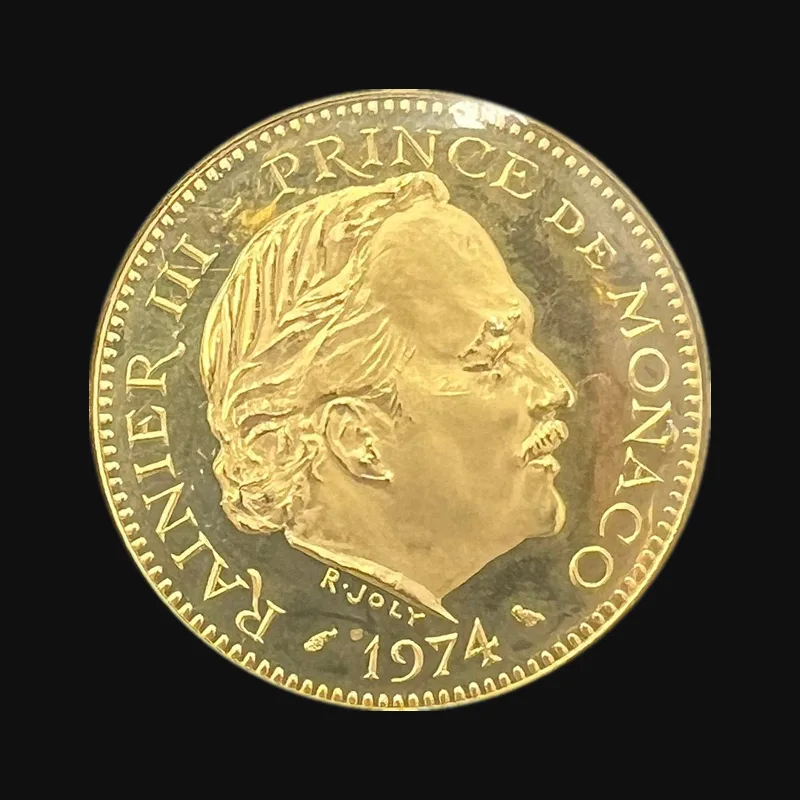
Start with the prince's name. LOUIS II marks the coins of 1945 to 1947: aluminium-bronze for the 1 and 2 francs, aluminium for the 5 francs, copper-nickel for the 10 and 20 francs. RAINIER III, prince from 1949, appears from 1950 to the last coins of 2000.
Then look for the signature, engraved small under the bust or in the field. It dates the coin better than its style: L. MAUBERT for 1945, P. TURIN for coins from 1946 to 1960, R. COCHET for the 1982 100 francs, R.B. BARON for the bimetallic 10 francs from 1989.
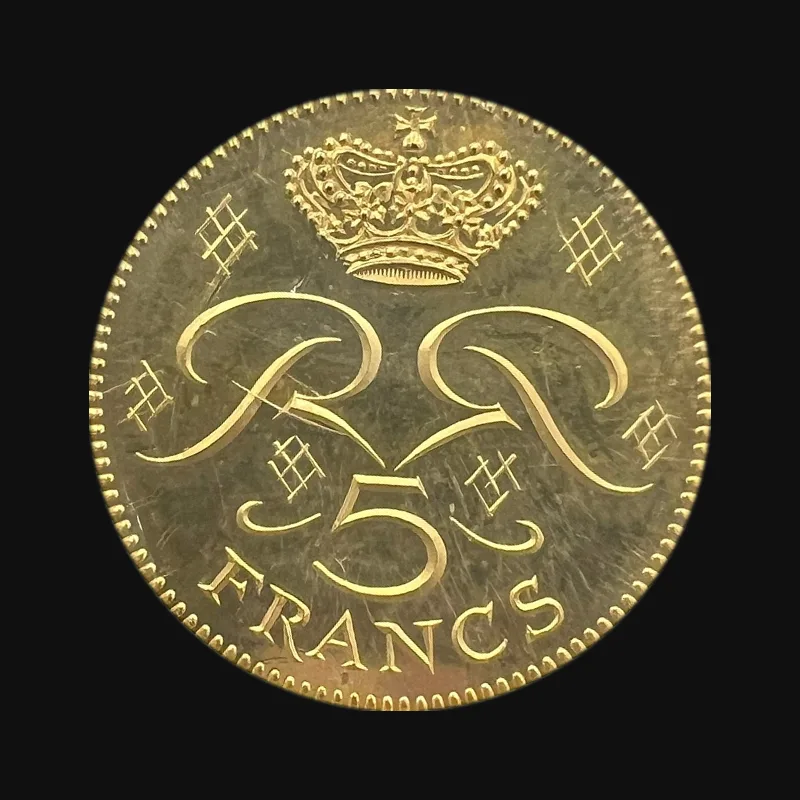
There is no mint letter, since everything was struck in Paris. As on French francs, though, small symbols often flank the date: these are the privy marks of the chief engraver. The owl matches Raymond Joly's years (1958-1974), the dolphin Émile Rousseau's (1974-1994), the bee Pierre Rodier's (1994-2001). Finally, the denomination is written either in full (“2 FRANCS”) or abbreviated (“5 F”, “10 F”).
Silver, gold and ESSAI: coins that stayed out of purses
Two silver types circulated. The 5 francs of 1960 and 1966, with Pierre Turin's effigy of Rainier III, contains 10.02 g of fine silver, like its French neighbour. The 1966 10 francs, a large 37 mm coin in 900‰ silver, shows on one side the profile of Prince Charles III with his reign dates, 1856-1889, and on the other the arms of Rainier III. It is signed by Maurice Delannoy. In 1982, a silver 100 francs paired Rainier III with Hereditary Prince Albert, after Robert Cochet.
Monaco had a large number of essais struck, recognisable by the word “ESSAI” in the field. They were sold to collectors, often cased: 500 sets of 1 and 5 francs in 1960, 1,000 essais of the 1966 10 francs on a proof flan, 1,700 essais of the 1950 100 francs in aluminium-bronze. Some are piedforts, struck on a thicker-than-normal flan.
Gold only appears on these collector pieces: a cased set of four gold essais of the 10, 20, 50 and 100 francs of 1950, and a gold piedfort of the 1982 100 francs, limited to 250. For other gold coins, see the 20 francs Napoleon III or ask through our coin identification page.
Not to be confused with
French coins of the same format. The silver Semeuse 5 francs has the fineness, weight and diameter of Rainier III's 5 francs. The French Génie de la Bastille 10 francs shares the 6.5 g weight and the alloy of the bimetallic Monaco 10 francs, with a very close diameter. Only the design and legend settle it.
An essai and a circulation coin. Both carry the same date and design. Look for the word “ESSAI”, a thicker flan or a mirror finish. An essai often has a smaller mintage than the circulation coin, but not always.
Rainier III's two old 100 francs. The 1950 coin measures 30 mm and weighs 12 g; the 1956 coin is only 24 mm and 6 g.
Monaco's euro coins. Struck since 2001 with the same reference to the principality, they form a separate series, covered on the page for the 2 euros of Monaco, the Vatican and San Marino.
Tokens and medals. Monaco produced many medals bearing the princes' profiles. With no amount in francs and no “DEO JUVANTE”, they are not coins.
Mintage, condition, presentation: what collectors look for
Most Monaco francs were struck in hundreds of thousands and are commonly found. Collectors look first at the mintage. In the 1970s and 1980s Monaco produced only small quantities of some denominations: 10,000 to 14,500 a year for the 5 francs from 1975 to 1979, 10,000 for the 1 and 5 centimes of 1982 and for the 1989 1/2 franc, and just 3,000 for the first bimetallic 10 francs of 1989.
Next comes condition. The 1945 aluminium coins scratch and dent easily. On the portraits, the prince's hair and ear wear first; on the reverse, check the crown and the detail of the mantle behind the arms. A coin taken from a set should keep its original lustre.
Keep cases and certificates: they document where an essai came from. And clean nothing, since cleaning leaves permanent marks. If in doubt, a numismatist can help through our coin identification page.