Skip to content
France

The gold 100 francs coin

France · 1855-1914 · Gold

Written by the Maison Or & Bijoux Cannes team · updated

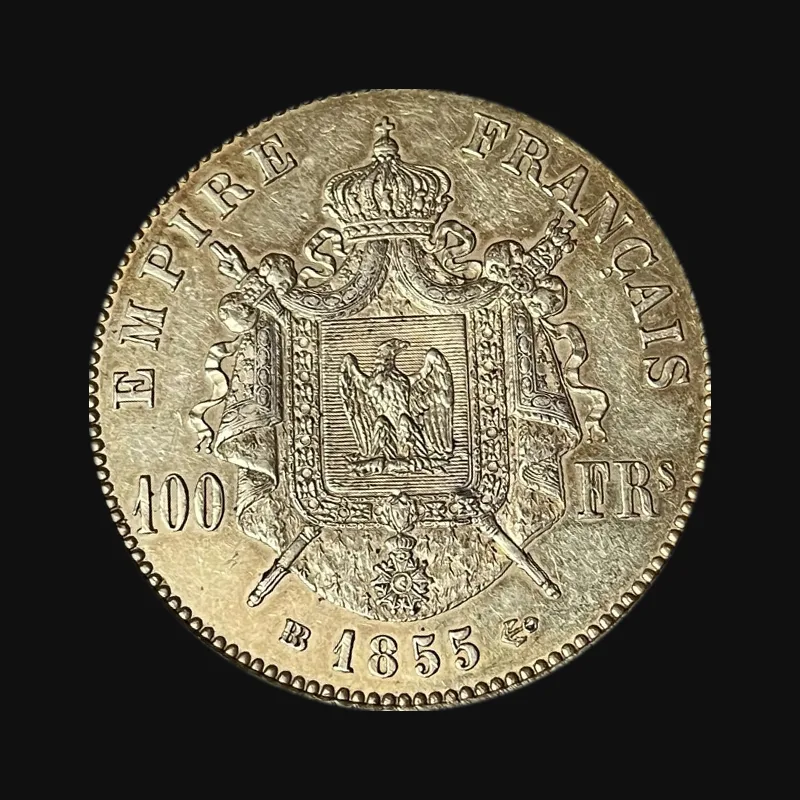
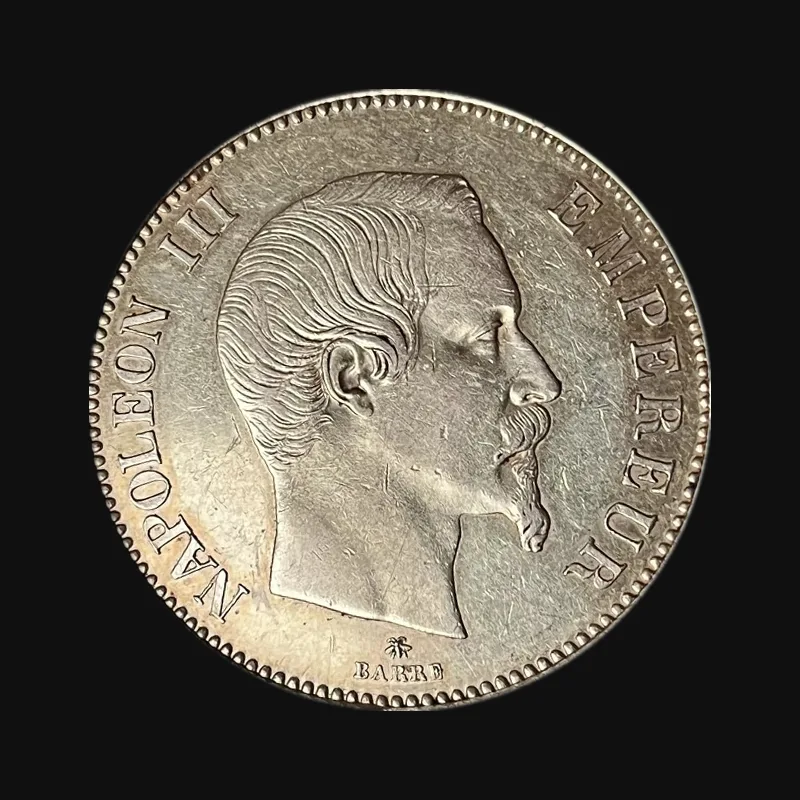
100 francs gold Napoleon III bare head, obverse100 francs gold dated 1855, reverse with the imperial arms
Photos: Maison Or & Bijoux.
Specifications
CountryFrance
MetalGold, 900‰ fine
Weight32.26 g
Fine gold29.032 g
Diameter35 mm
Types and datesBare head 1855-1859; laureate head 1862-1870; Genius 1878-1914
MintsParis (A) and BB under the Empire; Paris alone under the Republic
EngraversThe Barres (see identification); Genius after Augustin Dupré
Edge inscription“DIEU PROTEGE LA FRANCE”, then from 1907 “LIBERTÉ ÉGALITÉ FRATERNITÉ”
Coins struck by typeBare head: 346,514; laureate head: 96,950; Genius: 438,595
CataloguesLe Franc F.550 to F.553; KM 786, KM 802 and, for the 1878-1906 Genius, KM 832; Gadoury 1135, 1136 and 1137 (same split), according to CoinVarieties

Thirty-five millimetres and 32.26 g of 900 fine gold: no French circulating gold coin ever went beyond this size, which weighs as much as five 20 francs pieces. Three designs followed one another between 1855 and 1914, two portraits of Napoleon III and then the winged Genius of the Third Republic. On its own, the Genius was struck almost as often as the two imperial types put together.

Identification

The gold 100 francs coin: how to recognise it

100 francs gold Napoleon III bare head, obverse

Obverse

Under the Second Empire, a bust of Napoleon III facing right, bare-headed until 1859 and wearing a laurel wreath from 1862, with the legend “NAPOLEON III EMPEREUR” and the name BARRE engraved below the bust. Under the Republic, a standing winged Genius writes on a tablet, framed by a rooster and by a fasces topped with a hand of justice, with “RÉPUBLIQUE FRANÇAISE” around.

100 francs gold dated 1855, reverse with the imperial arms

Reverse

Imperial coins: the arms of the Empire, an eagle perched on a thunderbolt inside the collar of the Legion of Honour, set against a mantle; the legend “EMPIRE FRANÇAIS”, the value “100 FRS” split on either side of the arms, mint letter and year at the bottom. Genius: value and year in the middle of a wreath.

Edge
Raised lettering. Up to 1906, imperial and Genius coins alike read “DIEU PROTEGE LA FRANCE” (God protect France); Genius coins dated 1907 to 1914 carry the republican motto “LIBERTÉ ÉGALITÉ FRATERNITÉ”. Patterns and proof-like pieces have a plain edge.
Engraver
A family business, that of the Barres. Désiré-Albert signed the laureate head; BDOR and Abacor credit him with the bare head too, while CoinVarieties names his father, Jacques-Jean. The Genius is Désiré-Albert's engraving of the model Augustin Dupré created in 1792.
Dates and mintages

The gold 100 francs coin: key dates

This selection mixes both regimes. On the Empire side, it shows each mint's first date, the record year and an issue that hardly survived. On the Republic side, it brings out four tiny Genius years: 1889 with 100 coins, then 1894, 1887 and 1896.

The gold 100 francs coin: dates and mintages
DateMintCoinsComment
1855A50,901Series opens in Paris
1855BB5,049Series opens at BB
1856A56,803No BB striking
1857A103,447Empire record, Paris only
1859BBabout 14,700Total disputed (see note)
1862A6,650First laureate head in regular striking
1864A5,536
1865A1,517Lowest imperial total
1866A9,041
1869A28,872Peak of the laureate head
1869BB12,230 or 14,412Depending on the source
1870A10,460Almost entirely melted, according to BDOR
1878A12,814Genius; 30 proof-like pieces besides
1886A38,892Highest Genius year
1887A234Rare
1889A100Lowest mintage of the whole series
1894A143Rare
1896A400Rare
1899A10,000Yearly striking begins
1906A30,247“Dieu protège la France” edge
1907A20,000Republican edge
1914A1,281Made in 1921

Mintages taken from BDOR and Abacor, which give the same figures; types and subtypes follow Le Franc. The 1859 BB figure changes from one source to another: 14,710 at BDOR, 14,698 at CGB (quoting Le Franc 2023), 9,305 at CoinVarieties. So does 1869 BB: 12,230 for BDOR, 14,412 for CoinVarieties. Not shown here, among others: 1858, 1863, 1867 and 1868, as well as several Genius years.

Three questions to identify it

First question: who appears on the obverse? A bearded emperor with a pointed moustache means the Second Empire. If he wears a laurel wreath, the coin dates from 1862 to 1870; if not, from 1855 to 1859. A winged figure in the act of writing points to the Republic, from 1878 onwards.

Second question: which letter is on the reverse? On imperial coins it sits at the bottom, near the year. A stands for Paris, BB for the Alsatian mint, the only other one to strike this size. The Genius always carries A. The guide to French mints (in French) explains these letters.

Third question, for the Genius only: what does the edge say? The religious formula means a coin from 1906 at the latest, the republican motto a coin from 1907 or later. When edge and date disagree, the coin deserves a careful look.

The Empire: two mints, few coins

A decree of 12 December 1854 created both the 50 and the 100 francs in gold, according to BDOR and Abacor. Striking began in 1855, in Paris and at BB at the same time. Quantities stayed small for a gold coin: the best year, 1857, barely passed 100,000 pieces, and some dates count only a few thousand.

The work was shared unevenly. Paris struck alone in 1856 and 1857; the BB mint struck alone in 1863. With the laureate head, numbers fell further: 1,517 coins in Paris in 1865. Then the war of 1870 stopped everything. The 10,460 Paris coins of that last year were reportedly almost all melted down, according to BDOR, which explains their rarity.

The Genius, from world's fairs to 1921

The Republic took up the size again in 1878 and gave it Dupré's Genius, already in use on the gold 20 francs of the time (see gold coins, in French). The 1878 and 1889 dates match the two Paris world's fairs. For some twenty years striking stayed erratic: close to 39,000 coins in 1886, but only 100 in 1889.

From 1899, each year brought roughly 10,000 to 30,000 pieces, until 1913. The edge changed in 1907. The 1914 date was only struck in 1921, in 1,281 examples according to BDOR and Abacor. The same sources state that the law of 25 June 1928, which created the so-called Poincaré franc, took away the coin's legal tender status. The page on Third Republic coins (in French) puts these dates in context.

Special pieces and copies

Outside regular striking, Le Franc and BDOR list a few unusual pieces. In 1855, Paris made a plain-edged proof bearing the letter A on the obverse, along with patterns. BDOR mentions 1861 proofs on burnished flans, where a five-pointed star replaces the bee under the neck and a six-pointed star replaces the mint letter. Laureate head patterns dated 1862 and 1868 are also known.

For the Genius, 1878 has 30 pieces on burnished flans and two patterns; a burnished flan issue also exists for 1900. The year 1879 splits into two privy marks, the plain anchor and the barred anchor.

Like any large gold coin, the 100 francs has been imitated, in lower-grade gold or in gilt metal. Weigh it (32.26 g), measure it (35 mm), read the edge letter by letter and check how fine the hair or feathers are. The guide to spotting a fake coin (in French) goes through these steps.

Coins it gets confused with

The gold 50 francs carries exactly the same designs, but on 28 mm and 16.13 g, with “50 FR” on the reverse. The Napoleon III gold 20 francs repeats the imperial portraits on 21 mm.

Families in the area also hold gold 100 francs from Monaco, struck in Paris at the same diameter and weight under Charles III and then Albert I: the Grimaldi arms on the reverse and the words “CENT FRANCS” give them away. The Bazor gold 100 francs of 1929-1936, a small 21 mm coin that never circulated, and the late 20th-century silver 100 francs have nothing in common with this coin.

As for large foreign gold coins, such as the Mexican gold 50 pesos (in French), their legends tell them apart.

Spotting wear

The wide diameter shows wear more clearly than on a napoléon. On the bare head, the locks above the ear and the cheekbone lose their relief first; on the laureate head, the veins of the leaves. On the arms side, the eagle, the arrows of the thunderbolt and the links of the collar show the first signs.

On the Genius, the shoulder and torso of the figure flatten before the wings, then the rooster follows. The wreath on the reverse loses its veins.

Being heavy, these coins knock against each other easily: a lightly worn piece can be peppered with small marks, which count when the grade is judged. Never rub a coin to soften them. Look instead at the guide to coin grades and the page on whether to clean a coin (both in French).
In Cannes

The gold 100 francs coin on the French Riviera

The gold 100 francs went hand in hand with the rise of Cannes as a winter resort. After Lord Brougham settled there in 1834, wealthy English and then Russian families came for the season, and the town got its railway station on 10 April 1863, while the laureate head was in circulation. No source says how many of these large coins changed hands along the Croisette; they do turn up in estates across the area, often alongside napoléons. To have yours identified by a numismatist, ask for a free valuation.

The gold 100 francs coin: frequently asked questions

How do I tell a gold 100 francs from a gold 50 francs with the same design?

By size and weight: 35 mm and 32.26 g for the 100 francs, 28 mm and 16.13 g for the 50 francs. The reverse spells it out as well, “100 FRS” against “50 FR”.

My 100 francs Genius is dated 1912: what should its edge say?

“LIBERTÉ ÉGALITÉ FRATERNITÉ”, like every date from 1907 to 1914. The words “DIEU PROTEGE LA FRANCE” on a 1912 would be abnormal.

Is there a Napoleon III 100 francs dated 1860 or 1861?

Not in regular striking: the bare head stops in 1859 and the laureate head starts in 1862. BDOR only reports 1861 proofs on burnished flans, which Le Franc does not list.

Which Napoleon III year is the most plentiful?

1857, in Paris, with 103,447 coins. It is also a year in which the BB mint did not strike this size.