Skip to content
France

Monnaie de Paris gold and silver euros, coin by coin

France · depuis 2002 · Gold

Written by the Maison Or & Bijoux Cannes team · updated

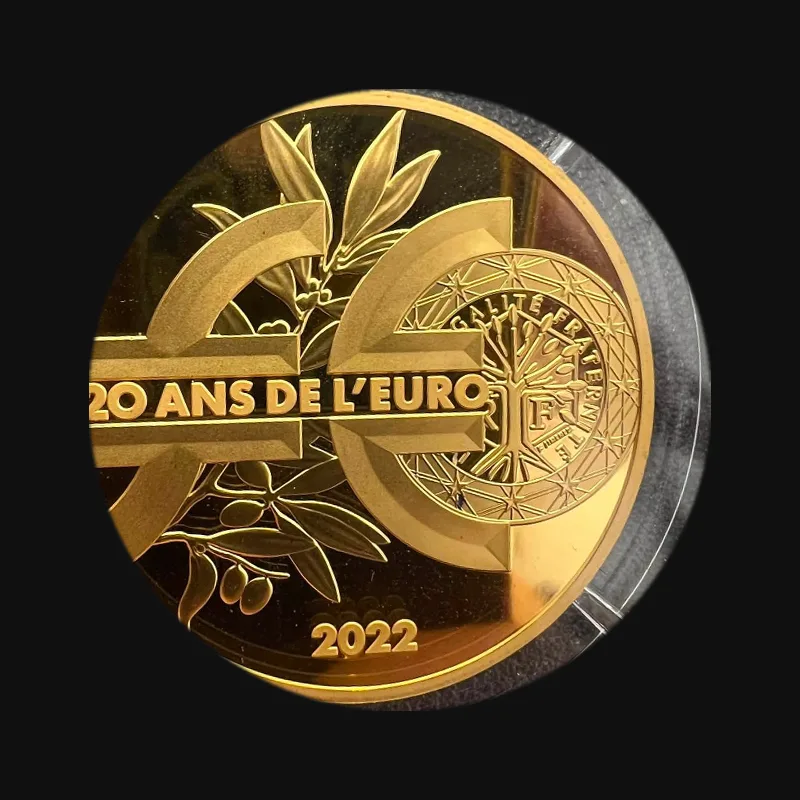
Gold coin “20 years of the euro” dated 2022, Monnaie de Paris, in its capsule
Photo: Maison Or & Bijoux.
Specifications
CountryFrance
MintMonnaie de Paris, struck at Pessac
Gold920, 999 or 999.9 fine depending on the issue
Silver333, 500, 900, 950 or 999 fine
Face valuesFrom 5 to 10,000 euros
FinishesBU (brilliant uncirculated) and proof
Since2002
Legal tenderFrance only
Origin markHorn of plenty

A 100-euro gold coin barely 15 mm wide, a 41 g silver 50 euros, a 10 euros drawn by Sempé: the collector euros of the Monnaie de Paris often puzzle the people who find them in a drawer. Issued since 2002, they are legal tender in France only and never circulate. Their face value says nothing about their metal; the series, the weight and the diameter are what place them.

Identification

Monnaie de Paris gold and silver euros, coin by coin: how to recognise it

Obverse

The pictorial side changes with each series: the Sower walking (2008-2010), map and landmarks of a region (2010-2012), Augustin Dupré's Hercules group redrawn by Joaquin Jimenez (2011-2013), drawings by Sempé (2014) or Uderzo (2015), Smurf characters in colour (2020).

Reverse

The value side carries the amount in euros, the year and RÉPUBLIQUE FRANÇAISE or RF. On the Sower, the regional euros or the Smurfs, the value sits between a laurel branch and an oak branch, with three hexagons and the motto. The horn of plenty is the Monnaie de Paris mark.

Edge
Plain on the 41 g silver 50 euros according to the dealer listings consulted; it varies on other issues.
Engraver
Joaquin Jimenez signed many of the value sides; some designs come from outside artists such as Sempé or Uderzo. The privy mark of chief engraver Hubert Larivière appears on coins until 2011.
Dates and mintages

Monnaie de Paris gold and silver euros, coin by coin: key dates

A selection weighted towards gold coins and large silver modules, plus the two Cannes Film Festival issues. New issues run to dozens every year, so the table keeps only the ones most often seen.

Monnaie de Paris gold and silver euros, coin by coin: dates and mintages
CoinSeriesYearMetal and sizeMintage
100 eurosSower walking2008 to 2010Gold 999.9, 3.1 g, 15 mm50,000 per date
250 eurosSower walking2009Gold 920, 8.45 g, 22 mm25,000
500 eurosSower walking2010Gold 999, 12 g, 31 mm25,000
250 eurosValues of the Republic, Peace2013Gold 999, 3.89 g, 23 mm50,000
500 eurosValues of the Republic, The Republic (Sempé)2014Goldn/a
10 euros60th anniversary of the Cannes Film Festival2007Gold 920, 8.45 g, 22 mm, proof500
20 euros60th anniversary of the Cannes Film Festival2007Silver 950, 155.5 g, 50 mm, proof500
50 eurosSower walking2010Silver 900, 36 g, 41 mm100,000
50 eurosPeace by Sempé (spring-summer, autumn-winter)2014Silver 900, 41 g, 41 mm50,000 for the spring-summer version
50 eurosAstérix and Peace (Uderzo)2015Silver 900, 41 g, 41 mm50,000 announced
50 eurosThe Smurfs, coloured2020Silver 900, 41 g, 41 mm20,000 per character
100 eurosHercules2011 to 2013Silver 900, 50 g, 47 mm50,000
20 to 10,000 eurosBicentenary of Napoleon's death2021Silver 999 and goldn/a

Sower and Hercules: Numismatiquement vôtre and Gold.fr; 2009 250 euros: Coin Varieties; 2013 250 euros and the 2014, 2015 and 2020 50 euros: CGB listings, with CoinsWeekly and Stash of Coins; Cannes Film Festival: Wikipedia and Stash of Coins. Catalogues disagree on the Astérix 50 euros mintage.

Face value is not metal

One face value can hide coins with nothing in common. The 2007 Cannes Film Festival 10 euros is gold, 920 fine; the 2012 Hercules 10 euros is 500 fine silver; Sempé's 2014 10 euros are only 333 fine. Reading the number is never enough.

Three checks settle most cases: note the year and the design, weigh to a tenth of a gram, measure the diameter with calipers. Then compare with the table. The fineness is not always struck on the coin; the series tells you.

Finally, look at the finish. A proof has a mirror field and frosted relief and comes in a case with a certificate; a brilliant uncirculated coin looks more even and comes in a blister, on a card or in a cardboard folder.

The small gold coins

Monnaie de Paris gold euros are often tiny. The 2008-2010 Sower 100 euros weighs 3.1 g for 15 mm; the 2013 Peace 250 euros, first year of the Values of the Republic series, 3.89 g for 23 mm. Their size is not a sign of an imitation.

Others are heavier: the 2009 Sower 250 euros, 920 fine, weighs 8.45 g, and the 2010 500 euros reaches 12 g for 31 mm. In 2014, the only gold coin in the series drawn by Sempé is a 500 euros titled The Republic.

These coins often come in a capsule. Leave it closed: a fingerprint on polished gold leaves a lasting mark, and the coin can be read through the plastic.

The 41 g silver 50 euros

From 2014 to 2020 the Monnaie de Paris kept one format for its pictorial 50 euros: 900 fine silver, 41 g, 41 mm. It is used for Sempé's two Peace 50 euros (June and September 2014), for the 2015 Astérix and Peace 50 euros, where Dogmatix holds an olive branch, and for the 2020 Smurfs, issued in colour.

The 2010 Sower 50 euros shares the 41 mm diameter but weighs 36 g, so the scale tells them apart at once.

On the Smurfs, colour is part of the original issue. On any other series, a painted or gilded coin was almost always decorated later by a private company.

False leads

  • Commemorative 2 euros, such as those from Monaco, the Vatican or San Marino: bimetallic circulation coins, valid across the euro area, with no precious metal.
  • Medals and souvenir tokens: even when struck by the Monnaie de Paris, they carry no face value in euros.
  • Coins coloured or gold-plated by a third party: the added decoration changes neither the metal nor the origin, and the packaging then does not bear the Monnaie de Paris name.
  • Silver Sower or Hercules francs, which inspired the 2008-2013 series: a value in francs rules them out.

Keeping a proof coin perfect

These coins leave the mint without circulating; handling is what damages them.

  • Fingers leave stains on a mirror field that never come off. Hold the coin by the edge, or better, leave it in its holder.
  • A cloth scratches the polish with every wipe.
  • 333 and 500 fine alloys, rich in copper, darken in open air.
  • Large modules of 41 to 50 g show the slightest knock on the edge.

More in our guides on coin grades, why not to clean a coin and checks against fakes, which mostly target gold.
In Cannes

Monnaie de Paris gold and silver euros, coin by coin on the French Riviera

In 2007 the Monnaie de Paris marked the 60th anniversary of the Cannes Film Festival with two proof coins: a 10 euros in 920 fine gold, 8.45 g and 22 mm, and a 20 euros in 950 fine silver, 155.5 g and 50 mm, each announced at 500 pieces. A cinema screen, the festival steps and a palm frame the legend “60E ANNIVERSAIRE DU FESTIVAL DE CANNES”. With mintages that small they are rarely seen; if a Cannes family owns one, the shop can identify it together with its case.

Monnaie de Paris gold and silver euros, coin by coin: frequently asked questions

Is my Cannes Film Festival 10 euros silver?

No, the 2007 10 euros is 920 fine gold and weighs 8.45 g. The silver coin for the same anniversary is a much larger 20 euros, 50 mm across.

A 15 mm gold 100 euros: is that right?

Yes. The Sower 100 euros struck from 2008 to 2010 holds 3.1 g of 999.9 fine gold; its small size is the one the Monnaie de Paris intended.

Are the colours on my Smurfs 50 euros original?

Yes, these 2020 coins were issued in colour. A painted coin from a series that was not coloured has, by contrast, been decorated by a third party.

Why does the Astérix 50 euros mintage vary between catalogues?

The Monnaie de Paris announced 50,000 pieces, but some catalogues report a reduced figure. Only an official record could settle it; bring the coin to a free valuation to have it identified.

More coins
Sources