From the 1892 reform to the end of the empire
In August 1892, Austria-Hungary replaced the florin (gulden) with the corona, divided into 100 heller, and moved to the gold standard. The law set one kilogram of fine gold at 3,280 corona, which gives the 10 corona its 3.0488 g of fine gold. The florin remained legal tender until 1 January 1900, at two corona to the florin.
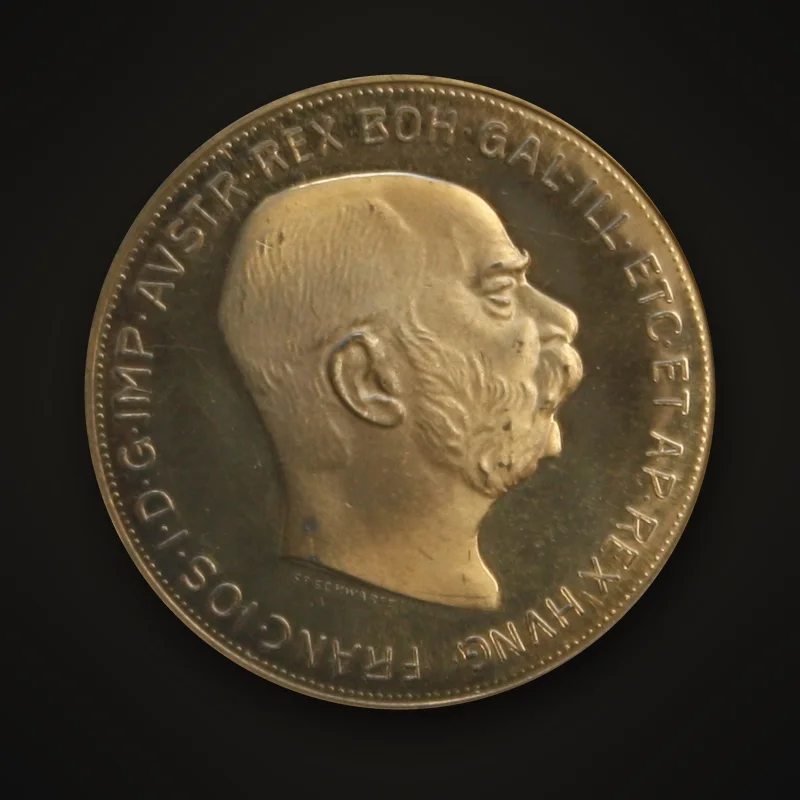
The 20 corona appeared in 1892. The 10 corona bears the dates 1892-1893, 1896-1897 and 1905-1906 according to Wikipedia (de); Numista regards the 1892 and 1893 pieces as patterns. The 100 corona came only in 1908, for the sixtieth anniversary of Franz Joseph's reign: its allegorical reverse bears the dates 1848 and 1908 and the legend “DVODECIM LVSTRIS GLORIOSE PERACTIS” (twelve lustra gloriously completed). In 1909, after a 10 and a 20 corona with Rudolf Marschall's portrait, all three denominations took Stefan Schwartz's portrait and the imperial eagle.
Original striking ended in 1912 for the 10 corona, 1914 for the 100 corona and 1916 for the 20 corona. Other gold coins of the same period include the Napoleon III 20 francs and the American 20 dollars.
Original or restrike? The landmarks
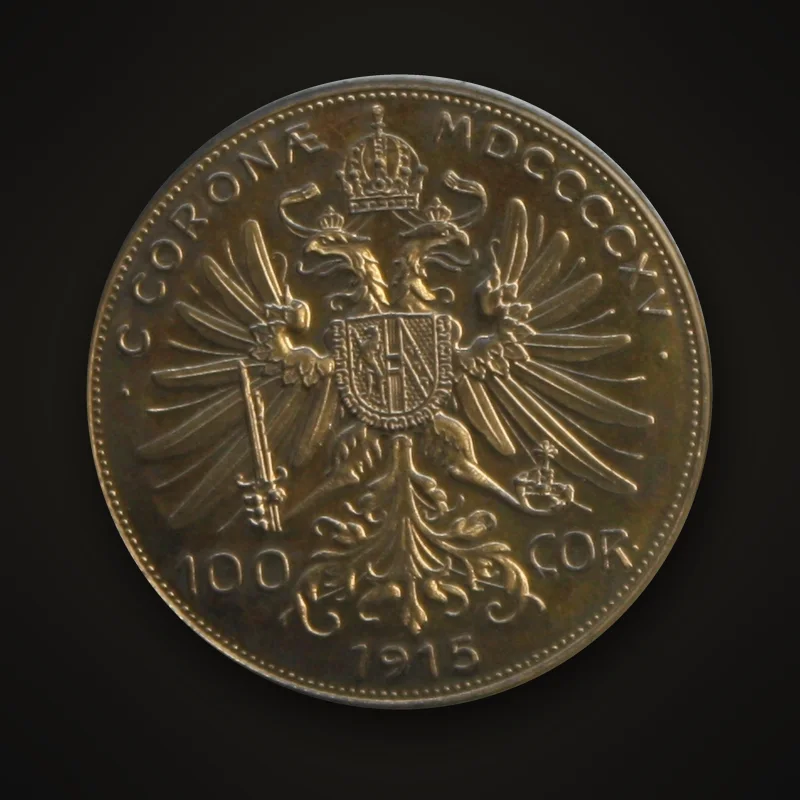
After the monarchy, the Vienna Mint resumed striking all three denominations with a frozen date: 1912 for the 10 corona, 1915 for the 20 and 100 corona. Same design, same weight, same 900‰ gold: these are official restrikes, not fakes. The sources disagree on their timeline. Dealers place the start in the 1960s or in 1975; Kettner ends the 100 corona in 1988 and the 20 corona in 1989, the 10 corona in the 1990s, while the Austrian Mint still offers all three restrikes for sale.
The date. This is the main landmark. A 20 corona dated 1909, 1912 or 1914 is an original; a 10 corona 1912 or a 100 corona 1915 is a restrike.
The look. A restrike is usually unworn, with a bright field. An original has often circulated: softened relief, small knocks on the edge. Wear alone does not date a 1915, but a heavily worn piece deserves a closer look.
The measurements. Scales reading to a hundredth of a gram and calipers rule out most imitations: 6.78 g and 21 mm for the 20 corona, 33.88 g and 37 mm for the 100. If doubt remains, ask a numismatist through our coin identification page.
The Hungarian korona
The Kingdom of Hungary struck its own gold coins, with the same weight and fineness, at the Kremnitz mint, now Kremnica in Slovakia. You can spot them by the “K·B” mark (Körmöcbánya) and the Hungarian legends. The obverse shows Franz Joseph standing, as King of Hungary, with the legend “FERENCZ JÓZSEF I. K. A. CS. ÉS M. H. S. D. O. AP. KIR.”; the reverse carries the crowned Hungarian arms held by two angels, the words “MAGYAR KIRÁLYSÁG” and the denomination in “korona”.
The 10 and 20 korona were struck from 1892 to about 1915; one variety of the 20 korona adds the arms of Bosnia between the angels (1913, 1914, 1916). The 100 korona exists in 1907, for the fortieth anniversary of the coronation, with a coronation scene, and in 1907-1908 with the standing king. Those two dates, 1907 and 1908, were also officially restruck: according to Wikipedia, the restrikes have a redder tint and relief that is not matt.
A Hungarian korona is therefore not a variety of the Austrian coin: it is a separate series, to be classed on its own.
Wear on a 900‰ gold coin
The 10% copper alloy resists scratches better than the pure gold of Austrian ducats, but original coronas circulated and show it. On Schwartz's portrait, look first at the top of the head, the ear and the side-whiskers, then the moustache: these are the high points that flatten first. On the 1892-1905 laureate head, look at the laurel leaves above the ear.
On the reverse, the eagle first loses the detail of its feathers and of the small crowns on its two heads; the central shield blurs next. The beaded border and the edge lettering also show knocks.
Restrikes, often kept in tubes or capsules, mostly show small contact marks and fingerprints on the bright field. Many coronas were also mounted as jewellery: solder marks, a loop, claw marks. Do not clean a gold coin, even a dull one: cleaning leaves permanent hairlines.
Not to be confused with
Austrian ducats. Also restruck with the date 1915, they are 986‰ gold and carry no denomination in figures.
The 1892 8 and 4 florins. These gold coins of the old system, also restruck by Vienna, show two denominations at once: 8 florins and 20 francs, or 4 florins and 10 francs. An 8 florins weighs the same as a 20 francs (6.45 g), slightly less than the 20 corona.
French and Latin Monetary Union 20 francs. Same 21 mm diameter and same fineness as the 20 corona, but 6.45 g instead of 6.78 g. See the Napoleon III 20 francs.
Hungarian korona. Same weight, but standing king, Hungarian legends and K·B mark.
Modern gold bullion. The 100 corona holds close to an ounce of fine gold (30.49 g), but it is not an ounce coin like the Krugerrand, which contains 31.10 g. For other gold coins, our gold coins page explains how the shop can help.