Skip to content
France

French royal silver écus, 1641 to 1793

France · 1641-1793 · Silver

Written by the Maison Or & Bijoux Cannes team · updated

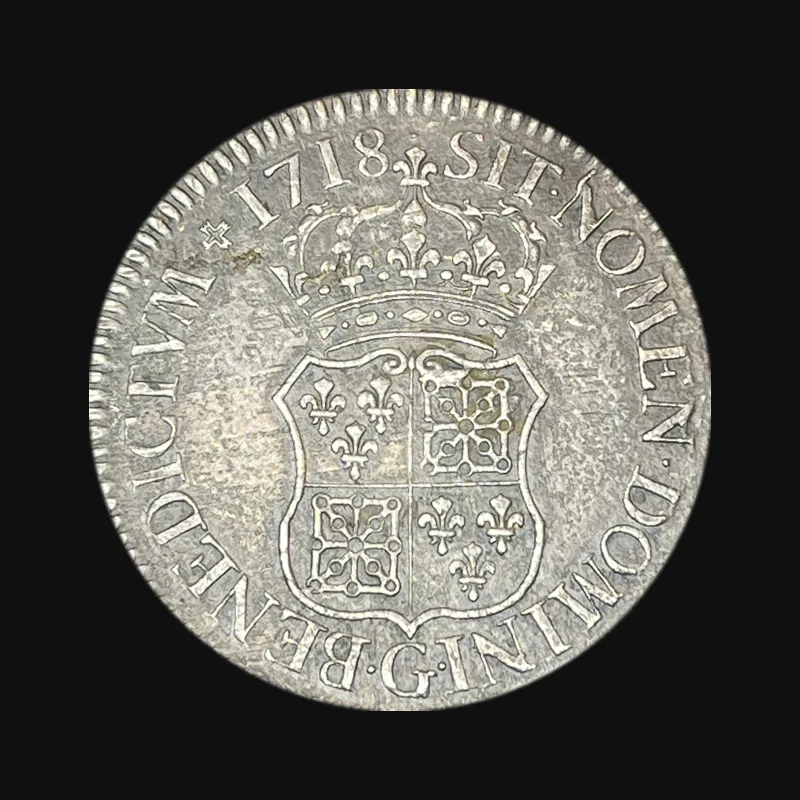
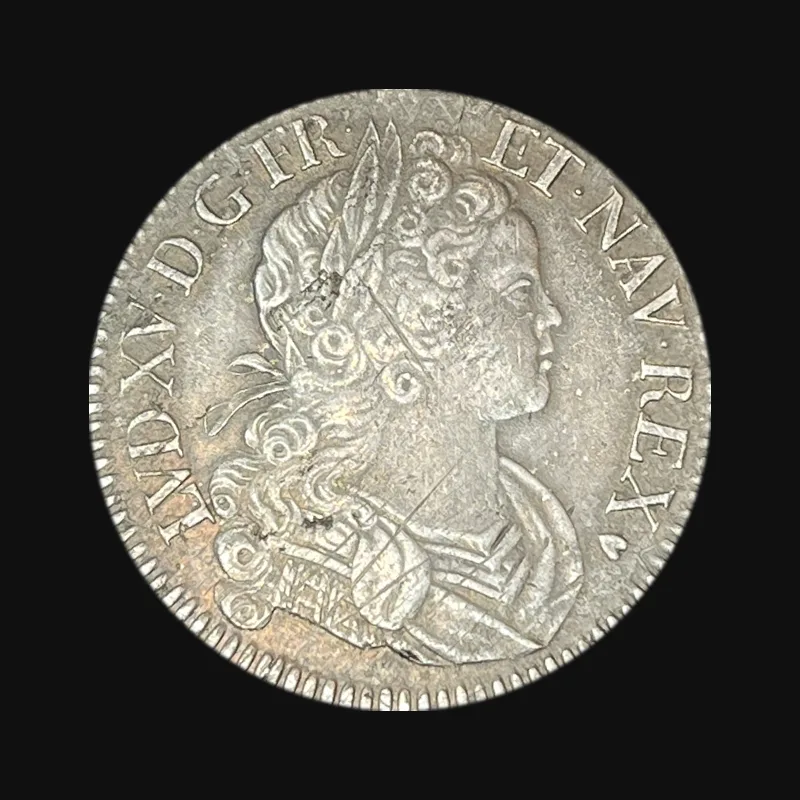
Silver écu of Louis XV, obverse with the young king’s bustÉcu dated 1718, reverse with the crowned arms of France and Navarre
Photos: Maison Or & Bijoux.
Specifications
CountryFrance
MetalSilver at 11 deniers, i.e. 917 fine
Legal weight27.45 g until 1709; 30.59 g from 1709 to 1718; 24.47 g for the France-Navarre écu; 29.488 g from 1726
DiameterBetween 37 and 41 mm
Period1641-1793
Face value3 livres at first, 6 livres from 1726
FractionsHalf, quarter, fifth, eighth, tenth and twentieth écu depending on the reign
Mint lettersA Paris, B Rouen, D Lyon, K Bordeaux, M Toulouse, & Aix, MA Marseille, BB Strasbourg, AA Metz, W Lille, among others
EngraversWarin, the Roettiers family, Duvivier
EdgeLettered in the eighteenth century, plain in 1641-1643
CataloguesGadoury (G. 217, 229, 317, 318, 322, 356); Droulers; Davenport

Roughly 40 mm across, about thirty grams of silver, a king called Louis and a Latin motto: the écu was the standard silver coin of the French monarchy from 23 December 1641 until 1793. Its weight moved with each monetary reform until it was settled at 29.488 g in 1726. Dozens of mints struck it, each one identified by a letter on the reverse. In family estates it often turns up next to its fractions, the half écu above all.

Identification

French royal silver écus, 1641 to 1793: how to recognise it

Silver écu of Louis XV, obverse with the young king’s bust

Obverse

The king's portrait, either a bust or a bare head, framed by his abbreviated Latin titles: “LUD. XVI. D. G. FR. ET NAV. REX” reads “Louis XVI, by the grace of God King of France and Navarre”. In the eighteenth century, Louis XV and then Louis XVI are shown in profile facing left.

Écu dated 1718, reverse with the crowned arms of France and Navarre

Reverse

Three broad families: a cross made of eight crowned L's, crowns or royal insignia, or the oval shield with three lilies under a crown, framed by olive branches. The motto “SIT NOMEN DOMINI BENEDICTUM” runs with the date; the mint letter sits below the shield or at the heart of the cross.

Edge
Plain on the Louis XIII écu; in the eighteenth century it is lettered “DOMINE SALVUM FAC REGEM”, Lord, protect the king.
Engraver
Four names mark the series: Jean Warin (Louis XIII), Norbert Roettiers (three crowns), Joseph-Charles Roettiers (Louis XV with headband) and Pierre-Benjamin Duvivier (Louis XVI).
Dates and mintages

French royal silver écus, 1641 to 1793: key dates

The table is split by weight period rather than by year: the scales, more than the date, will first tell you which family your écu belongs to. The Regency types are listed in detail, because their heavier or lighter standards are often misleading. The mintages quoted are only examples taken from the Droulers reference.

French royal silver écus, 1641 to 1793: dates and mintages
PeriodKingType nameLegal weightWorth noting
1641-1643Louis XIIILouis d'argent or écu blanc27.45 gEngraved by Warin, plain edge; in Paris in 1643, a dot privy mark and a rose privy mark
c. 1643-1680Louis XIVShort lock, long lock, youthful bust27.45 gThree successive portraits of the young king; date ranges vary by mint
1690-1701Louis XIVEight L's, then palms27.45 gReminting years: an older design sometimes shows through the new one
1709-1715Louis XIVThree crowns30.59 gThe heaviest écu; 7,335,848 struck in Paris for 1709
1715-1718Louis XVVertugadin30.59 gChild king; round arms of France; very often struck over an older écu
1718-1720Louis XVFrance-Navarre24.47 gCrowned shield quartered with France and Navarre
1726-1740Louis XVOlive branches29.488 gFirst 6-livre écu; 517,925 pieces for 1738 BB
1740-1770Louis XVHeadband29.488 gRibbon in the hair; kept on at a few mints after 1770
1770-1774Louis XVOld head29.488 gThe aged king, last portrait of the reign
1774-1792Louis XVIDraped bust, olive branches29.488 gDuvivier's signature; 309,200 in Paris in 1775
1792-1793Louis XVIConstitutional, genius type29.48 gGenius writing the Constitution, “REGNE DE LA LOI”

Weights and mintages: Coinvarieties, after Droulers, Davenport and Gadoury; France-Navarre and vertugadin écus from the Coinvarieties 1716-B page and the CGB 1718 Rouen listing. Issues of 1720 to 1725 and the Louis XIV cravat and insignia types are left out.

Three steps to place an écu

Read the king. The obverse legend begins with LUD. and a numeral: XIII, XIIII for Louis XIV, XV or XVI. It is the first clue and the most reliable one.

Weigh it. A Louis XVI écu should come close to 29.49 g. A coin of 30.5 g points to the end of Louis XIV or the start of Louis XV; at about 24 g, think of the France-Navarre écu of 1718-1720, which is not necessarily worn. A gap of more than a gram that you cannot explain deserves a closer look.

Find the letter. On the reverse, below the shield or in the middle of the cross, a letter or symbol names the mint. Our numismatists can identify it during a free valuation.

The Regency and its shifting weights

When Louis XIV died in 1715, the new king was five years old. The first écus of the reign, known as vertugadin, kept the high 30.59 g standard and were largely struck on older coins: on some, traces of the earlier design remain visible at the top of the head.

In 1718 came the France-Navarre écu, much lighter, with a shield shared between the lilies of France and the chains of Navarre. During John Law's system, value and weight then changed several times; the vertugadin, for instance, was raised to 15 livres in July 1720 before being demonetised in September.

Only in 1726, under Cardinal Fleury, did a stable 6-livre écu return, and its weight did not change again until the Revolution.

Overstrikes, privy marks and period forgeries

Under Louis XIV and early Louis XV, the state chose to restrike old écus rather than melt them down. These reformed flans show fragments of the old legend: a historical feature, which catalogues distinguish from strikes on new blanks.

The small symbols slipped into the legends, the privy marks, identify the mint director and the engraver, and they create varieties within one date. The BB mint's écus of 1792-1793 thus read “FRANÇAIS” instead of “FRANÇOIS”.

As for counterfeits, eighteenth-century fakes are often cast or plated: too light, porous surface, badly formed edge letters. Recent copies target sought-after types and give themselves away with a mushy relief and an approximate diameter.

The écu's relatives

Before 1640, the écu was a gold coin, decorated with a sun and without a portrait: nothing like the big silver piece. In the nineteenth century, the name survived for the silver 5 francs, easy to recognise by its French legend and its 25 g weight.

The half écu faithfully repeats the écu's design on a flan of about 14.7 g and 30.5 to 33 mm. The smaller fractions look much alike: scales settle the question better than the eye.

Finally, the olive-branch écu crossed borders: in southern Germany and Switzerland it was called the Laubtaler, and some carry a Bern countermark. These are genuine French écus.

Wear, toning and holes

Look first at the hair just above the ear, then the cheek and shoulder: these are the first reliefs to fade. On Louis XVI écus, the embroidery of the coat disappears early and gives a good idea of circulation.

On the reverse, watch the crown above the shield. If its pearls run together and the olive leaves no longer stand out, the coin was in use for a long time.

Many écus were pierced to be worn as pendants or rubbed to make them shine. Cleaning shows up as micro-scratches and an over-bright white; an even toning, by contrast, is sought after. Leave the coin as it is.
In Cannes

French royal silver écus, 1641 to 1793 on the French Riviera

Under the Ancien Régime, Cannes was a Provençal market town, and some of the écus circulating there came from the mints of Provence. After the Aix mint was abolished in 1786, Marseille took over from 1787, with the letter MA. The Droulers reference, cited by Coinvarieties, records 243,443 Louis XVI écus dated 1790 there. Marseille also struck the constitutional écu in 1792-1793, a date described as scarce. An écu marked MA found in a family around Cannes therefore belongs to the very end of the monarchy. You can bring such coins to the shop to have their type and mint identified.

French royal silver écus, 1641 to 1793: frequently asked questions

My écu weighs about 24 g: is it necessarily very worn?

No. The France-Navarre écu, struck in 1718-1720, had a legal weight of 24.47 g. Check the reverse: a shield shared between France and Navarre points to this type.

What does MA on the reverse of an écu mean?

It is the mark of the Marseille mint, opened in 1787 to replace the one at Aix. You will therefore only find it on Louis XVI écus of the last years.

Why can I see old letters under the design?

Because the coin was restruck on an older écu, common practice between about 1690 and 1718. It is not a sign of a fake; a numismatist can name the original type.

An écu and a half écu look alike: how do I tell them apart?

By size and weight. The Louis XVI écu measures about 39 mm for nearly 29.5 g, the half écu 30.5 to 33 mm for about 14.7 g.