Skip to content
Belgium, Italy, Switzerland

Gold 20 francs of Belgium, Italy and Switzerland

Belgium, Italy, Switzerland · 1861-1914 · Gold

Written by the Maison Or & Bijoux Cannes team · updated

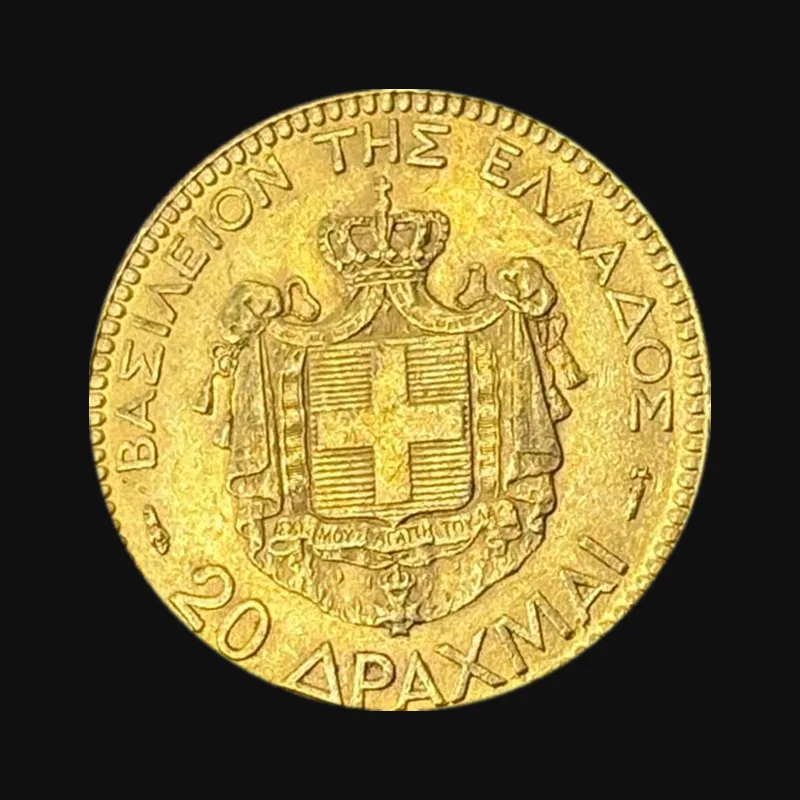
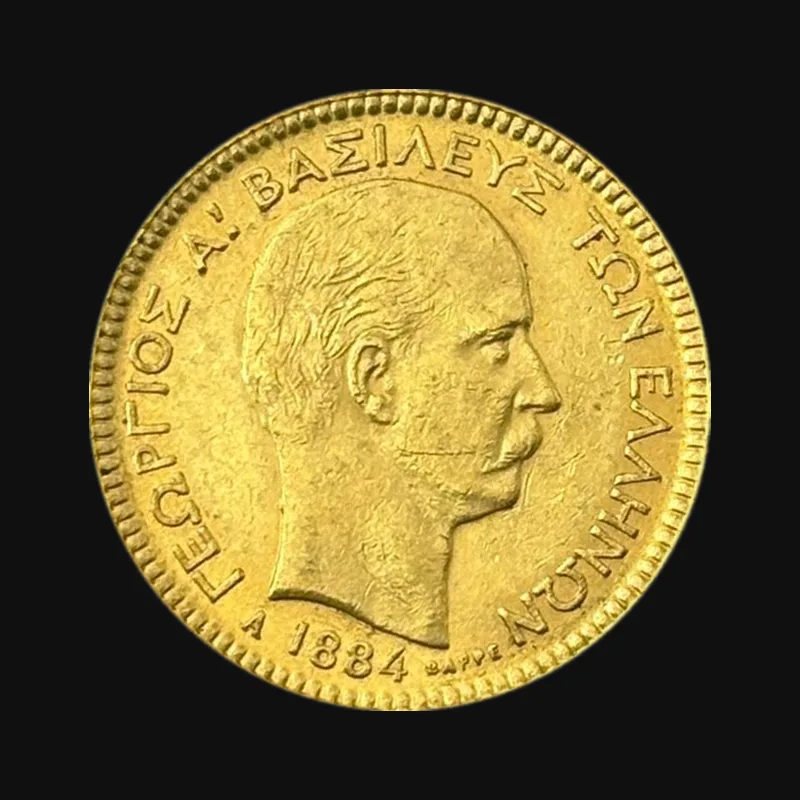
20 drachmai gold of George I of Greece dated 1884, obverse20 drachmai gold of Greece, reverse with the royal arms
Photos: Maison Or & Bijoux.
Specifications
CountryBelgium, Italy, Switzerland
MetalGold, 900‰ fine (10% copper)
Weight6.45 g (6.4516 g)
Fine gold5.806 g
Diameter21 mm
Years struck1865-1882 then 1914 in Belgium; 1861-1897 in Italy (Victor Emmanuel II and Umberto I); 1883-1896 in Switzerland (Helvetia)
MintsBrussels; Turin (T), Milan (M) and Rome (R) in Italy; Bern in Switzerland
EngraversBy type: Wiener and Devreese (Belgium), Ferraris and Speranza (Italy), Walch and Bühler (Switzerland)
EdgeLettered or reeded depending on the country
ReferencesMorin 281 and 282 for the Belgian 1914 (French, Flemish); KM 10.2 and Pagani 472 for the 1875 R 20 lire

A “napoléon” with an unfamiliar portrait, a legend in Italian or Latin: more often than not, this is a coin struck outside France under the monetary convention of 1865. Belgium, Italy and Switzerland issued gold pieces of 20 francs, or 20 lire, interchangeable with the French ones. Their format never changes: 21 mm, 6.45 g, gold of 900 fineness. Only the ruler, the arms and the language of the legend give away the country of origin.

Identification

Gold 20 francs of Belgium, Italy and Switzerland: how to recognise it

20 drachmai gold of George I of Greece dated 1884, obverse

Obverse

On Belgian coins the royal profile faces right: Leopold I (“LEOPOLD PREMIER”) for the 1865 date, then Leopold II (“LEOPOLD II ROI DES BELGES”), with the engraver's signature L. Wiener; Albert I's only year, 1914, comes with either a French or a Dutch legend. The kings of Italy face left, Victor Emmanuel II (“VITTORIO EMANUELE II”) and later Umberto I (“UMBERTO I RE D'ITALIA”). Switzerland shows a woman's head wearing a diadem that reads “LIBERTAS”, below the Latin legend “CONFOEDERATIO HELVETICA”.

20 drachmai gold of Greece, reverse with the royal arms

Reverse

On the Belgian side, the lion shield is topped by a crown, with “20 FRANCS” and the year. On the Italian side, the crowned shield of the House of Savoy carries “L. 20”, a mint letter and, in the time of Victor Emmanuel II, the words “REGNO D'ITALIA”. On the Swiss side, a star stands above the cross shield, amid sprays of oak and olive; it reads “20 FR” and gives the date.

Edge
Belgian pieces carry the raised words DIEU PROTEGE LA BELGIQUE, Italian ones have a reeded edge. The Helvetia is reeded in 1883; for the later years, most catalogues record an edge lettered DOMINUS PROVIDEBIT.
Engraver
Léopold Wiener engraved the effigies of Leopold I and Leopold II, Godefroid Devreese that of Albert I in 1914. In Italy, Giuseppe Ferraris signed the Victor Emmanuel II type and Filippo Speranza the Umberto I type. Switzerland owes its Helvetia to a design by Albert Walch and Christian Bühler, while Karl Schwenzer cut the dies.
Dates and mintages

Gold 20 francs of Belgium, Italy and Switzerland: key dates

Dates are listed in chronological order, with the countries mixed together. Two reigns supply most of the coins you come across: Leopold II in Belgium and Umberto I in Italy. The mintages worth a second look lie elsewhere: the 1861 Turin 20 lire, the Rome dates of Victor Emmanuel II and several Helvetia, two of them struck in fewer than thirty pieces.

Gold 20 francs of Belgium, Italy and Switzerland: dates and mintages
YearCountry and typeMintMintageRemarks
1861Italy, Victor Emmanuel IIT3,267Year the kingdom was proclaimed.
1865Belgium, Leopold IBrussels1,548,066531,963 pieces struck in 1866 bear the 1865 date.
1867Belgium, Leopold II, heavy beardBrussels1,341,307Leopold II, first type.
1870Belgium, Leopold IIBrussels3,191,203Plentiful date.
1873Italy, Victor Emmanuel IIRn/aRome, very rare date.
1875Italy, Victor Emmanuel IIR51,000Small mintage.
1877Belgium, Leopold II, fine beardBrussels5,906,070Most-struck Belgian year.
1882Belgium, Leopold IIBrussels522,000End of Leopold II's reign.
1882Italy, Umberto IRn/aCommonest year of Umberto I.
1883Switzerland, HelvetiaBern250,000Start of the series.
1887Switzerland, HelvetiaBern176Major rarity.
1888Switzerland, HelvetiaBern4,224Very small mintage.
1893Italy, Umberto IR41,214Scarce date.
1893Switzerland, Helvetia (Gondo gold)Bern25Punch mark on the shield.
1895Switzerland, Helvetia (Gondo gold)Bern19Punch mark on the shield.
1896Switzerland, HelvetiaBern400,000End of the series, largest mintage.
1914Belgium, Albert IBrussels125,000Both legends combined.

Partial list. Belgian figures: StashOfCoins and CoinVarieties, checked for 1875, 1876 and 1882, and Numisview for 1914. Italian figures: NumisBids for 1861 T, CoinVarieties for 1875 R, CollectorsKey for 1893. Swiss figures: Bdor and Kettner Edelmetalle, which agree.

Belgian, Italian or Swiss: the legend decides

Weight and diameter are no help in telling these coins apart, since they are the same everywhere. Everything happens on the obverse.

  • A king facing right and the words “ROI DES BELGES” or “KONING DER BELGEN”: a Belgian coin.
  • A king facing left and an Italian legend, “VITTORIO EMANUELE II” or “RE D'ITALIA”: an Italian coin.
  • A woman's head with a diadem and “CONFOEDERATIO HELVETICA”: a Swiss Helvetia.

Then note the year and, for Italy, the letter on the reverse. With these three details, the table of dates tells you at once whether the coin belongs to a plentiful date or a small mintage. A modest magnifier and light from the side are enough to read a worn date; never scratch the surface.

The kings of Italy and their mints

Victor Emmanuel II, King of Sardinia who became King of Italy in 1861, had his 20 lire struck in three cities: Turin (letter T), Milan (M), then Rome (R) from the 1870s. On Turin and Milan pieces, the letter sits beside the initials “BN” of the Banca Nazionale. Some 11.7 million coins came off the presses from 1861 to 1878, yet the opening Turin date remains obscure, with just over 3,000 pieces, and Rome produced some very thin years, 1873 and 1875 in particular.

His son Umberto I reigned from 1878 to 1900. His 20 lire, around 8.8 million pieces dated 1879 to 1897, all come from Rome. Among them, 1884, 1889, 1891, 1893 and 1897 are regarded as rare; Bdor counts only 9,775 pieces for 1884.

In Italy these coins are nicknamed marengo, a reminder of the gold 20 francs the Subalpine Republic issued after the battle of Marengo, won by Bonaparte on 14 June 1800. It is the exact counterpart of the French “napoléon”.

Copies, varieties and signs of use

Copies. The rarer an Italian date, the more it has been imitated: a large share of the examples of these dates in circulation are said to be false, and some fakes are themselves made of gold. A correct weight is therefore not enough. Examine the edge, the crispness of the lettering and the overall consistency: an Umberto I piece bearing the letter T or M has no reason to exist. The guide to spotting a fake coin (in French) sets out the checks: reconnaître une fausse pièce.

Belgian varieties. Leopold II first appears with a thick, crudely detailed beard, from 1867 to 1870, then with a more finely worked one. Depending on how the reverse is oriented against the obverse, catalogues list two positions for some years. The 1865 date also exists with a misspelt signature, “L. WINNER”.

Gondo gold. The Helvetia of 1893 and 1895 made from metal of the Gondo mine, in the Valais, show a small punch mark in the middle of the shield and a lighter colour.

Wear and mounts. Look first at the high points: Leopold II's beard and locks, the Italian rulers' moustaches, Helvetia's diadem and hair, then on the reverse the lions' manes, the collar around the Savoy shield and the Swiss foliage. Many of these coins were worn as pendants or brooches: solder on the edge betrays it, just as parallel scratches betray a cleaning. Two guides in French cover this: grades and cleaning.

Other gold of the same module

The 21 mm, 6.45 g 20 francs was adopted by many other issuers, which adds to the hesitation when sorting.

  • French 20 francs, in the name of the emperor or the Republic: the Napoleon III 20 francs or the Rooster 20 francs, for instance.
  • Sardinian 20 lire, struck before 1861 by Victor Emmanuel II as King of Sardinia: same standard, but no “REGNO D'ITALIA”.
  • The 20 lire of Victor Emmanuel III, in the 20th century, with other designs.
  • The Swiss Vreneli, which replaced the Helvetia from 1897: a young woman with plaits in front of the mountains.
  • The 20 francs of Charles III of Monaco, dated 1878 and 1879.
  • Greek 20 drachmai and Austro-Hungarian 8 florins (1870-1892), matched to the value of 20 francs.

A common currency ahead of its time

Long before the euro, four countries brought their coins into line. On 23 December 1865, meeting in Paris, the Belgian, French, Italian and Swiss delegates agreed on common weights and fineness for gold and silver; each signatory undertook to accept the others' coins in its public treasuries. Greece joined them in 1868.

The gold 20 francs became the benchmark coin of the group, and Belgium, Italy and Switzerland struck millions of them. The system did not survive the First World War: gold stopped circulating in 1914, Belgium pulled out late in 1925 and the Union came to an end on 1 January 1927. The coins stayed in bank vaults and family safes, which is why they still turn up so often.
In Cannes

Gold 20 francs of Belgium, Italy and Switzerland on the French Riviera

The railway reached Cannes on 10 April 1863, when the section of the Marseille line starting at Les Arcs opened; it got to Nice the following year, then to the Italian border at Ventimiglia on 18 March 1872, where it met the Ligurian coast line. Cannes thus found itself on the rail route linking France and Italy along the shore. Latin Union gold coins, accepted by the public treasuries of both countries, had no border to cross: in Cannes estates, it is not unusual to find a 20 lire or a Belgian 20 francs among the napoléons.

Gold 20 francs of Belgium, Italy and Switzerland: frequently asked questions

My coin reads “L. 20”, not “20 FRANCS”: does it hold as much gold?

Yes. The Italian lira was pegged to the franc: a 20 lire weighs 6.45 g of gold at 900 fineness, or 5.806 g of pure gold, like a French or Belgian 20 francs.

Can an Umberto I 20 lire be marked T or M?

No. Under Umberto I, every 20 lire was struck in Rome and carries the letter R. Any other letter paired with this king should raise the suspicion of a counterfeit.

How can I spot a Helvetia struck from Gondo gold?

These pieces, dated 1893 or 1895, have a small punch mark in the centre of the reverse shield and paler gold. Only a few dozen were struck.

Does the 1914 Belgian 20 francs come in two versions?

Yes: Albert I's legend is either in French or in Flemish (Morin 281 and 282). The 125,000 coins of this date cover both versions. To have yours identified, ask for a free valuation.