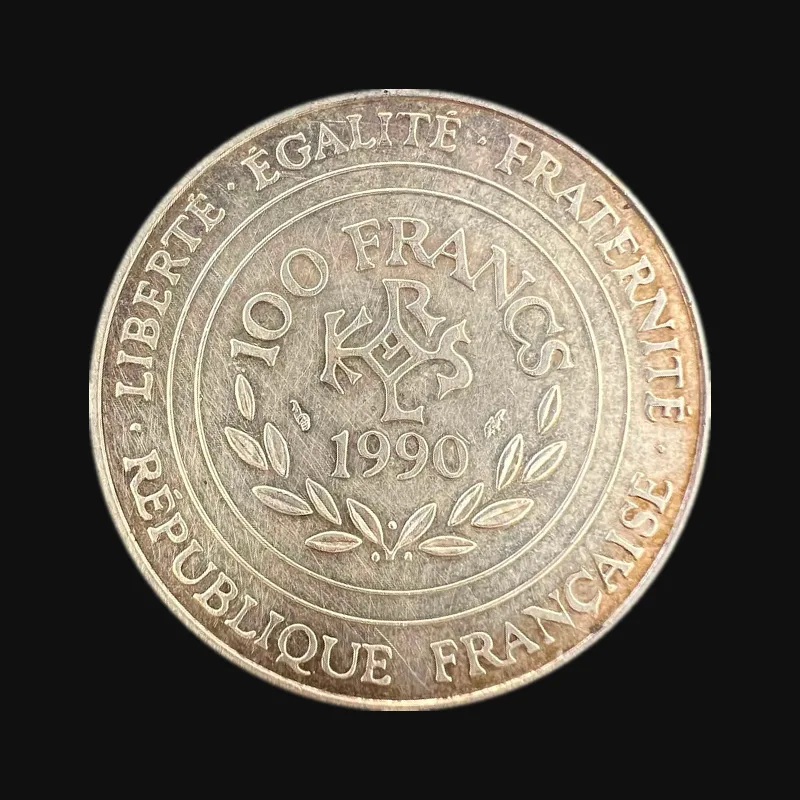
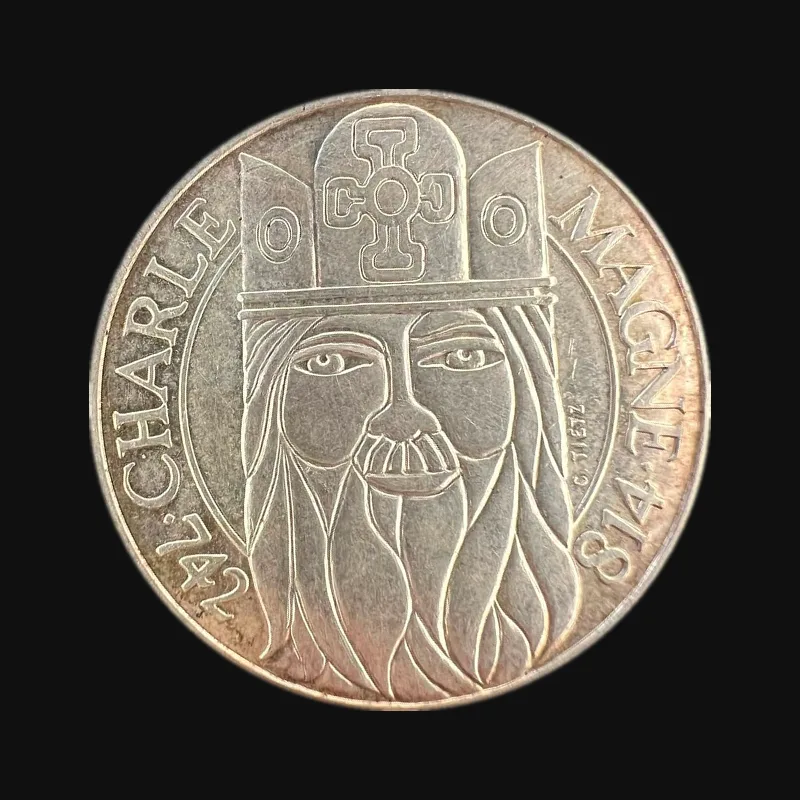
Reading your coin in thirty seconds
- The main design. A building with a dome and columns: Panthéon, go to step 2. A person, a statue, a scene: commemorative, go to step 3.
- The Panthéon date. 1982 to 1984 were produced by the million; from 1987 every year matters, since mintages fall to a few tens of thousands and then a few thousand.
- The commemorative subject. Each theme was struck in one year only, so the subject alone dates the coin. Find it in the table.
- The finish. A mirror field, a case or a certificate points to a collector version, to be kept apart.
To place these coins among the other new-franc issues, see new franc coins (in French).
Look-alikes that are not part of the series
- Monaco francs of the 1980s and 1990s, in the name of Prince Rainier III: they do not belong to the French series. See Monaco francs.
- The 100 francs Cochet of 1954 to 1958, an old-franc coin in white metal with no silver.
- The 10 and 50 francs Hercule of the 1960s and 1970s: same 900‰ standard, but 25 g and 30 g.
- Collector 100 francs issued in cases, in another size or metal, such as the 1993 Louvre (20,000 in silver) or the gold Marie Curie (5,000).
- Trial pieces, marked ESSAI, of which each subject had a few hundred to a few thousand.
Dolphin, bee and careful finishes
The dolphin is the symbol chosen by Émile Rousseau, in post as Chief Engraver from 1974 to 1994. Pierre Rodier's bee succeeds it: on the Panthéon, it is present from 1995. Two Panthéon coins of identical style are thus told apart by this small symbol.
Several subjects were also delivered in more careful finishes and in small numbers: Marie Curie in proof (1,000), Zola in proof (5,000) and uncirculated (50,000), La Fayette in brilliant uncirculated (25,000). The Panthéon has its proof version from 1991 to 2001. Keep the original packaging with the coin.
Wear, toning and counterfeits
These coins mostly slept. So you look less for wear than for storage accidents: fine hairlines in the broad field, knocks on the edge, black or bluish stains left by old sachets and rolls. On the Panthéon, the top of the cupola and the pediment soften first; on a portrait, it is the cheek, the nose and the hair. Avoid any silver cleaner, which scratches the surface. Grading terms are explained in the grading guide (in French).
A copy often gives itself away by weighing under 15 g, sometimes by sticking to a magnet, and by blurred relief. A cast coin shows a grainy field. Detailed method: spotting a fake coin (in French).
From 1982 to the euro
In 1982, no other French coin in circulation was made of silver: the precious metal stood out among the nickel and aluminium bronze. Dieudonné's Panthéon became the standard type. Too heavy and too valuable, the coin quickly went into drawers; by 1987, the Paris Mint was striking only 81,000 Panthéon coins.
The first commemorative, Marie Curie, came out in 1984. Writers, scientists, the republican motto, the Revolution, founding kings and the anniversaries of 1944-1945 followed. After 1992, mintages melted away, down to the 1997 Malraux.
The euro closed the series. Until 2001, the Panthéon was produced only for sets. Franc coins were no longer accepted in shops in 2002, and the Banque de France stopped taking them back in February 2005.