Skip to content
France

The silver 5 francs écu, from the Directory to 1878

France · 1795-1878 · Silver

Written by the Maison Or & Bijoux Cannes team · updated

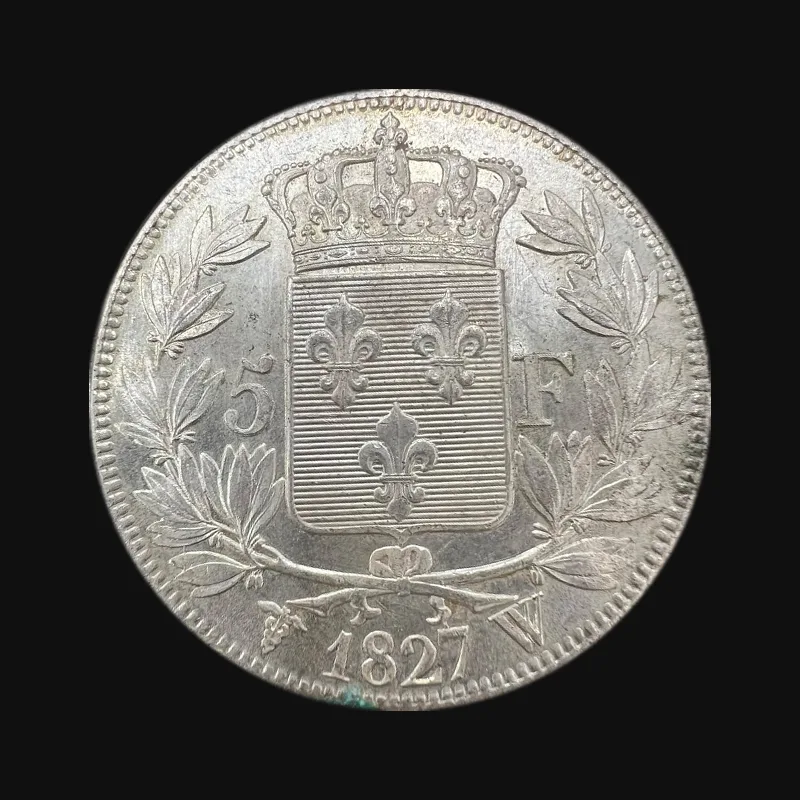
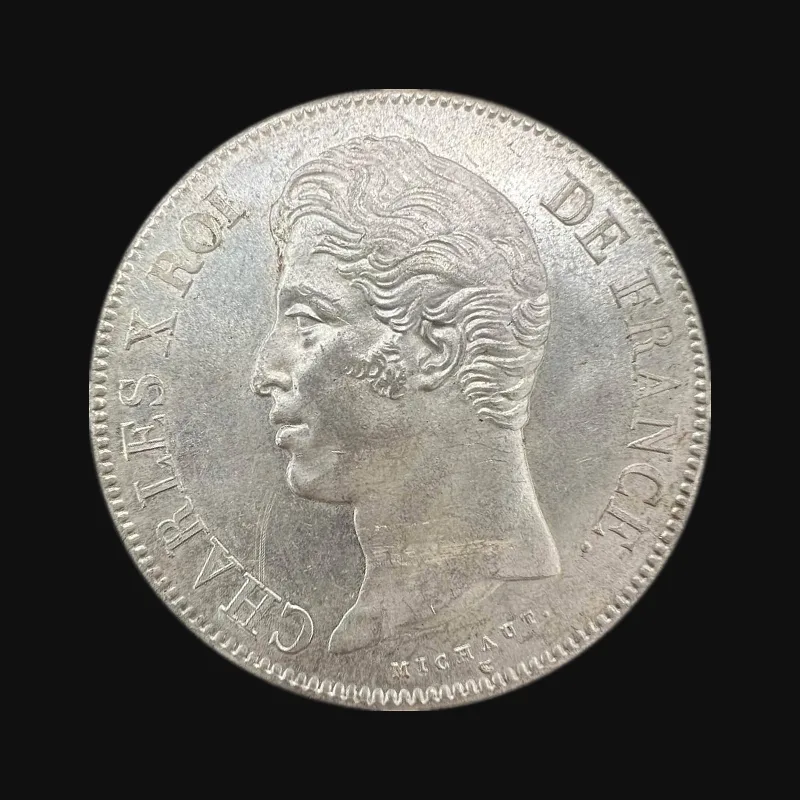
5 francs silver of Charles X, obverse5 francs of Charles X dated 1827, reverse with the crowned arms of France
Photos: Maison Or & Bijoux.
Specifications
CountryFrance
MetalSilver, 900‰ fine
Weight25 g
Pure silver content22.5 g
Diameter37 mm
EdgeIncuse or raised lettering, wording set by each regime
Years struckYear 4 (1795-1796) to 1878
Main mintsA (Paris), BB, K (Bordeaux); D (Lyon), W (Lille), Q (Perpignan), T (Nantes), MA (Marseille) depending on the period

Eight successive governments put their image on the same silver disc: 25 g at 900‰ fine, 37 mm across. This 5 francs écu, struck from Year 4 of the Republic to 1878, stayed in everyday use until 1914 and still turns up in many family drawers. Four clues place it: the design, the date, the mint letter and the wear.

Identification

The silver 5 francs écu, from the Directory to 1878: how to recognise it

5 francs silver of Charles X, obverse

Obverse

Three main designs take turns. Hercules, flanked by two female figures, carries “UNION ET FORCE” under the Directory, then the republican motto in 1848 and from 1870 to 1878. The portraits always come with the ruler's title: Napoleon, Louis XVIII, Charles X, Louis-Philippe, Napoleon III. Finally, the head of Ceres sits beneath the words “REPUBLIQUE FRANÇAISE”.

5 francs of Charles X dated 1827, reverse with the crowned arms of France

Reverse

Two families on the reverse: the value “5 FRANCS” ringed by foliage (republican types, Napoleon I, Louis-Philippe), or a crowned coat of arms (Louis XVIII, Charles X, laureate Napoleon III). The year and mint letter are always there, between two tiny symbols called privy marks.

Edge
The edge is lettered: “GARANTIE NATIONALE” for the Directory Hercules, the Latin “DOMINE SALVUM FAC REGEM” for the two Restoration kings, “DIEU PROTEGE LA FRANCE” for most other types. The first Louis-Philippe écus of 1830 and 1831 come with the letters either incuse or raised.
Engraver
Going by the type names used by CoinVarieties and Le Franc: Augustin Dupré for the 1795 Hercules, Tiolier and then Joseph-François Domard for Louis-Philippe, Eugène-André Oudiné for Ceres, and Jean-Jacques Barre with his son Albert-Désiré for Louis-Napoleon and Napoleon III.
Dates and mintages

The silver 5 francs écu, from the Directory to 1878: key dates

A set of landmarks rather than a full catalogue: date and mint combinations run into the hundreds. The rows deliberately mix very common years with small issues. Keep in mind that a scarce date means little if the coin is badly worn.

The silver 5 francs écu, from the Directory to 1878: dates and mintages
TypeYearMintMintageRemarks
Hercules, DirectoryYear 4An/kFirst date, Paris only.
Napoleon Emperor1809 to 1814A, BB and othersn/k“EMPIRE FRANÇAIS” on the reverse.
Napoleon, Hundred Days1815A and othersn/kStruck for a few weeks after the return from Elba.
Louis XVIII bare head1816 to 1824A, BB and othersn/kLatin motto on the edge.
Charles X1824 to 1830A, BB and othersn/kTwo versions of the portrait.
Louis-Philippe, Tiolier and Domard1830 to 1831A, BB and othersn/kTen or more varieties.
Hercules, Second Republic1848A16.6 to 16.8 millionVery common.
Hercules, Second Republic1848Dabout 146,000Small Lyon issue.
Hercules, Second Republic1849A29.1 to 29.3 millionAmong the most plentiful.
Ceres, Second Republic1849 to 1851A, BB and othersn/kHead engraved by Oudiné.
Napoleon III bare head1854 to 1859A, BB and Dn/kSigned Barre.
Napoleon III laureate head1867BB4,337,636Frequent.
Napoleon III laureate head1870A6,246,264Frequent.
Ceres without legend1870K569,662Bordeaux, Government of National Defence.
Hercules1871A237,906Bee mark.
Hercules, Paris Commune1871A256,410Trident mark; Le Franc's figure, disputed by some dealers.
Hercules1872K20,994Very low mintage.
Hercules1873A26,974,890Most plentiful date of the type.
Hercules1878K363,130Last Bordeaux date.
Hercules1878Aabout 1,150Tiny issue, rare according to BDOR.

Mintages from BDOR (Hercules of 1848-1849 and 1872-1878) and from CoinVarieties, which relies on the 2014 edition of Le Franc for 1867 BB, 1870 and 1871; Krause gives 4,224,000 for 1867 BB. A range means BDOR and Le Franc disagree. “n/k”: no reliable published mintage for that type or period.

Sorting your écus in four questions

Which design? A group of three figures means Hercules; a man's profile means the Empire, a king or Napoleon III; a woman's head crowned with wheat ears means Ceres. The title engraved around the portrait settles any doubt.

Which date? Under the Directory and early in the Consulate, the year follows the revolutionary calendar (Year 4, Year 9…). The Gregorian calendar returns under the Empire.

Which mint? The letter next to the date names the mint that struck the coin: A for Paris, K for Bordeaux, D for Lyon, BB, W, MA and others. The guide to French mints lists them.

What condition? The same date can come heavily worn or almost untouched, and that is often what matters most.

From the law of Year III to the halt of 1878

The franc was created by the law of 28 Thermidor Year III, that is 15 August 1795, which also provided for a large silver coin designed by Augustin Dupré. Eight years later, the law of 7 Germinal Year XI defined the franc as 5 g of silver at 900‰; the 5 francs coin therefore weighs 25 g, a standard that never changed.

Each government changed the picture, not the metal: Bonaparte and then the Emperor, the two Bourbon kings, Louis-Philippe, the republicans of 1848, Napoleon III, and finally the Third Republic, which brought Hercules back. In 1865, the Latin Monetary Union aligned the écus of Belgium, Switzerland and Italy on this model, making them interchangeable with the French ones.

As silver lost value against gold, the Latin Union countries stopped striking these coins: 1878 is the last date. Écus already issued kept circulating until the Great War. To set the coin in its century, see the page on the 19th century.

Copies, period fakes and small symbols

Privy marks. On either side of the date, two tiny symbols identify the mint director and the chief engraver. They tell apart coins of the same year and letter: in Paris in 1871, the bee marks ordinary écus and the trident those of the Commune, when Zéphirin Camélinat ran the mint.

Re-cut dates. Directory dies stayed in use for several years, so one numeral can be seen struck over another, for instance Year 6 over 5 or Year 8 over 5. Catalogues list them as separate varieties.

Fakes. Imitations in tin or base alloy circulated as early as the 19th century, and modern reproductions add to them. Scales (25 g), calipers (37 mm) and a look at the edge weed out most of them; a cast coin also gives itself away through a grainy surface and soft lettering. The guide spotting a fake coin explains these checks.

Wear: where to look

Some stayed in use for over a century, so these écus are mostly found in Fine or Very Fine; without wear they become uncommon, all the more so before 1848.

  • Hercules: the hero's chest and knee, his hand on Liberty's shoulder, the drapery of the two women.
  • Portraits: the hair near the ear, the cheekbone, the laurel leaves; on Louis-Philippe, the curls at the nape.
  • Reverse: the relief of the foliage around the value, or the engraving of the arms and their crown.

Their weight also explains the frequent knocks on the rim and in the field. Do not rub a tarnished écu: cleaning leaves a flat white look that collectors dislike. More in the grading guide and in our advice before any cleaning.
In Cannes

The silver 5 francs écu, from the Directory to 1878 on the French Riviera

On 1 March 1815, Napoleon landed in the Golfe-Juan bay with just over a thousand men back from Elba. After a failed attempt on Antibes, the column reached Cannes, where it set up its first bivouac; a plaque on the church of Notre-Dame-de-Bon-Voyage recalls the event. So began the Hundred Days, during which the mints went back to striking a 5 francs écu in the Emperor's name, dated 1815. An écu of that year found in an estate in Cannes deserves a close look, since Louis XVIII also had coins dated 1815 struck. A numismatist settles the question during a free valuation.

The silver 5 francs écu, from the Directory to 1878: frequently asked questions

How can I recognise a Hundred Days écu?

It is dated 1815, reads “NAPOLEON EMPEREUR” and carries “EMPIRE FRANÇAIS” on the reverse. An 1815 écu with the portrait of Louis XVIII belongs to a different issue.

Is a 5 francs écu always silver?

Genuine coins from 1795 to 1878 all are, at 900‰. Later 5 francs pieces, such as the 1960s Semeuse, are much smaller and are not écus.

My écu has a K: where was it struck?

At the Bordeaux mint. The letter appears on the 1870 Ceres and on several Third Republic Hercules coins, including 1872, struck in very small numbers.

Should I clean a blackened écu?

No. The toning protects the coin and shows its age; cleaning leaves fine scratches and an artificial shine that reduce its appeal.