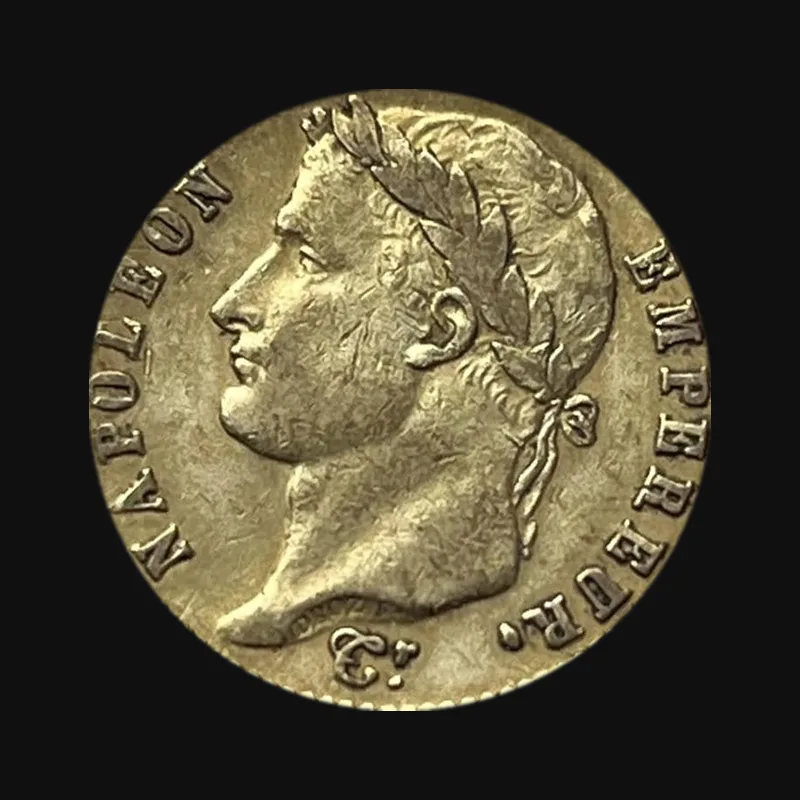
Obverse
Profile portrait looking left. The earliest type reads “BONAPARTE PREMIER CONSUL”; from Year 12 the legend becomes “NAPOLEON EMPEREUR”. Up to 1807 the head is bare; from 1807 it wears a laurel wreath.
Written by the Maison Or & Bijoux Cannes team · updated
| Country | France |
|---|---|
| Metal | Gold, 900‰ fine |
| Weight | 6.45 g |
| Fine gold | 5.806 g |
| Diameter | 21 mm |
| Years struck | Year XI (1803) to 1815 |
| Types | 7 in all, from the First Consul (Years XI-12) to the laureate head with Empire reverse (1809-1815) |
| Mints | Paris (A) for the bulk; provinces: H, I, K, L, M, Q, T, W; outside present-day France: Turin (U), Genoa (CL), Rome (crowned R), Utrecht (mast) |
| Mintage of the Empire type | 13,833,717 coins (1809-1814) and 463,682 in the Hundred Days |
| Engraver | Tiolier (Consulate and Year 12), then Droz |
| Edge | “DIEU PROTEGE LA FRANCE” |
| References | KM 651, 674, 695; Gadoury 1020 and 1025; Le Franc F.510-F.516A |
Six and a half grams of gold, 21 millimetres, a profile of Bonaparte: the 20 francs of the Consulate and the First Empire opened, in 1803, the long line of gold coins of the franc. Its date may be written the revolutionary way (AN XI, AN 13) or in the usual manner, and its legend changes with the regime. Close to 20 million pieces were struck up to 1815, most of them in Paris between 1809 and 1814.
Profile portrait looking left. The earliest type reads “BONAPARTE PREMIER CONSUL”; from Year 12 the legend becomes “NAPOLEON EMPEREUR”. Up to 1807 the head is bare; from 1807 it wears a laurel wreath.
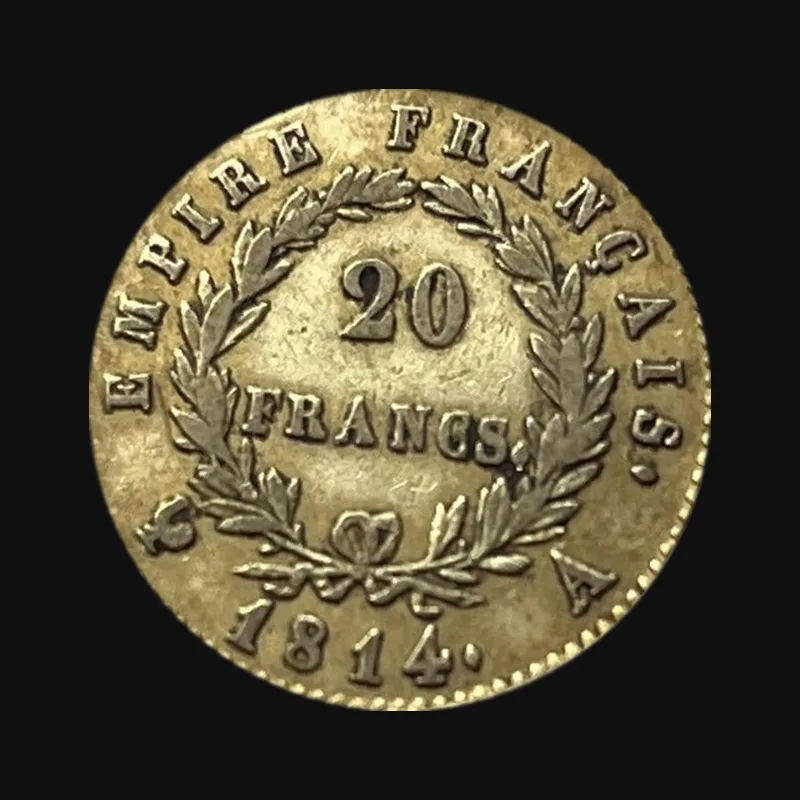
In the centre of a wreath, the value “20 FRANCS” and the date; below the wreath, the mint letter. Around it, “REPUBLIQUE FRANÇAISE” on coins dated up to 1808, “EMPIRE FRANÇAIS” afterwards. Dates stay revolutionary (AN XI to AN 14) until 1805 and become Gregorian in 1806.
The table runs in chronological order and stresses three moments: the beginnings of the Consulate, the years of very heavy striking in Paris and the year 1815. Provincial or Italian letters appear when their output falls to a few thousand pieces, or even a few hundred. For a date missing from the table, the letter A remains by far the likeliest.
| Year | Mint | Mintage | Remarks |
|---|---|---|---|
| Year XI | A | 58,262 | Year of creation, lowest Consulate mintage |
| Year 12 | A | 988,244 | Bonaparte First Consul |
| Year 12 | A | 428,143 | Imperial legend, reverse still republican |
| Year 13 | A | 518,871 | Droz's first bare head |
| Year 13 | Q | 522 | Perpignan |
| Year 14 | A | 148,308 | Last revolutionary date |
| 1806 | A | 963,896 | Gregorian date, one-year type |
| 1807 | A | 581,934 | Bare head known as the “big head” |
| 1807 | A | 244,476 | Arrival of the laurel |
| 1808 | A | 1,449,781 | Laurel, Republic reverse |
| 1808 | K | 281 | Bordeaux, tiny mintage |
| 1809 | A | 688,252 | “EMPIRE FRANÇAIS” reverse |
| 1810 | A | 1,936,194 | Large or small rooster |
| 1811 | A | 3,705,489 | Peak of production |
| 1812 | A | 3,072,365 | Common date |
| 1813 | A | 2,798,409 | Common date |
| 1814 | A | 327,603 | Year of the abdication |
| 1815 | A | 435,981 | Hundred Days, Paris |
| 1815 | L | 18,332 | Hundred Days, Bayonne |
| 1815 | W | 9,369 | Hundred Days, Lille |
Mintages taken from the BDOR tables, type by type; dates and mints checked against the Le Franc catalogue list (F.510 to F.516A); totals per type compared with Wikipedia. From one reference work to another, the numbers can differ by a few hundred or thousand: Coinvarieties gives, for instance, 962,929 for 1806 A and 3,702,681 for 1811 A. A selection only: the type with the Empire reverse alone counts 42 year and mint combinations.
On 28 March 1803, the law of 7 Germinal Year XI gave France a currency that would last until the First World War. The silver franc weighed 5 g; gold was struck in 20 and 40 francs pieces, 900 thousandths fine, and one kilogram of alloy yielded 155 coins of 20 francs. Hence the weight of 6.45 g that every 20 francs gold coin would respect up to 1914.
The new coin took over from the royal louis d'or, so much so that people long went on saying “louis”. The word “napoléon” apparently caught on later, rather under the Second Empire, according to Wikipedia. After 1815, the following regimes kept the weight, the diameter and the edge inscription: only the portrait changed.
Few coins changed so much in so little time. Tiolier first engraved Bonaparte First Consul, struck in Year XI and Year 12. The proclamation of the Empire, in Year 12, switched the legend to “NAPOLEON EMPEREUR” without touching the reverse, which still proclaimed the Republic.
Droz then took over the portrait. His bare head is dated Year 13 and Year 14, then 1806, first year of the return to the Gregorian calendar. In 1807, a broader head, called the “big head”, served as a transition before the laureate head, introduced the same year.
Last change: under a decree of 22 October 1808, the reverse reads “EMPIRE FRANÇAIS” from 1809. This type, by far the most abundant, was used again in 1815 during the Hundred Days, in Paris, Bayonne and Lille; nothing then sets it apart from the years 1809-1814 except the date.
The letter A of Paris appears on the vast majority of pieces. Provincial mints often worked gold for only a year or two, in small quantities: 281 coins in Bordeaux (K) in 1808, 501 in La Rochelle (H) in 1809, 522 in Perpignan (Q) in Year 13.
Conquests added unexpected letters. Turin (U) struck from Year 14; Rome, with a crowned R, Genoa (CL) and Utrecht, marked by a mast, came on stage between 1812 and 1814. Apart from Utrecht, which reached 90,183 pieces in 1813, these distant strikings are counted in thousands.
Under a loupe, varieties also show up: a large or small rooster in Paris in 1810, a “horn” flaw under the laurel on some 1808 M, a wide or narrow date in Rome, Turin and Lille, “1813” or “18 13” in Utrecht, a 5 re-engraved over a 4 in Paris in 1815. The Year 12 Emperor is also met in medal strike, or with “FRANÇAISE” deprived of its final dot.
To assess wear, start from the high points of the portrait: locks above the ear, temple, cheekbone. The laurel says a lot: on a lightly circulated coin, each leaf keeps its vein, whereas prolonged circulation merges them into a smooth band. On the reverse, the sharpness of the wreath leaves and of the lower bow gives a good measure; the legends, for their part, hold out too long to serve as a guide.
Mounted as a pendant or a brooch, a napoléon often keeps the scar of a solder joint on the edge, usually above the head. Do not rub it to make it shine: cleaning leaves irreversible micro-scratches. To go further, see the guide to grades of condition and the one devoted to cleaning coins (both in French).
Counterfeits exist, including some in 900‰ gold. Check the weight (6.45 g), the diameter (21 mm) and the alignment of the edge letters. A pasty relief or a grainy field are suspicious. A rare date, Year XI or an uncommon mint, justifies a close look at the figure and the letter: a retouch can disguise an ordinary coin. The full method is in the guide to counterfeit coins (in French).
The Hundred Days, during which the last 20 francs in the Emperor's name were struck, began on this coast. On 1 March 1815, Napoleon landed at Golfe-Juan with some 1,100 men; after a failed attempt on Antibes, the troop reached Cannes, where it set up its first bivouac, before heading off towards Grasse. A plaque on the church of Notre-Dame-de-Bon-Voyage, by the sea, recalls this halt. Coins dated 1815 reading “NAPOLEON EMPEREUR” are therefore contemporary with this episode, even though they were struck far from here, in Paris, Bayonne and Lille. You can bring your coin to the Cannes shop to have its type and mint read, or ask for a free coin valuation.
The imperial design is the same. But 1814 saw the abdication, and in 1815 Louis XVIII also struck 20 francs with his own portrait. A coin of 1815 in the name of “NAPOLEON EMPEREUR” belongs to the Hundred Days; only Paris, Bayonne (L) and Lille (W) struck it.
No, it is Year XI of the revolutionary calendar, that is 1802-1803. It is also the year the coin was created, with only 58,262 pieces in Paris, which makes it the most sought-after date of the First Consul.
Paris, letter A, by a long way. The other letters, from La Rochelle to Utrecht, often have mintages of a few thousand or even a few hundred coins.
Partly. A bare head points to Year 13 to 1807, a laureate head to 1807 to 1815, and the legend “BONAPARTE PREMIER CONSUL” to Year XI or Year 12. The “EMPIRE FRANÇAIS” reverse places the coin in 1809 or later.